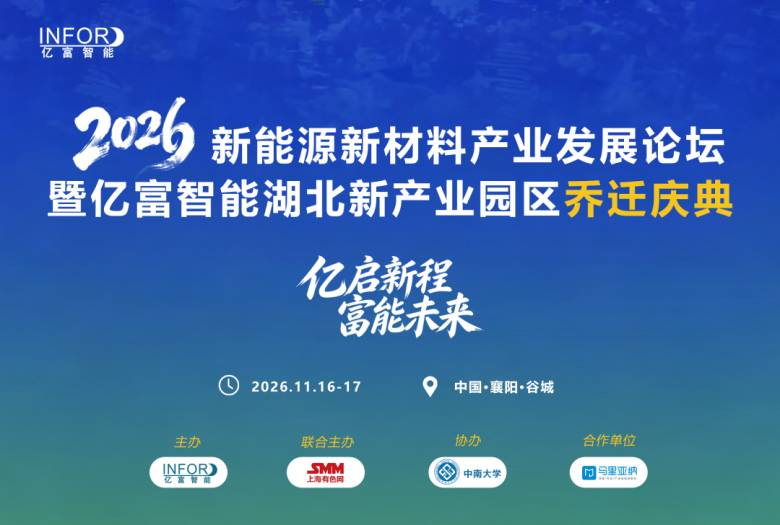
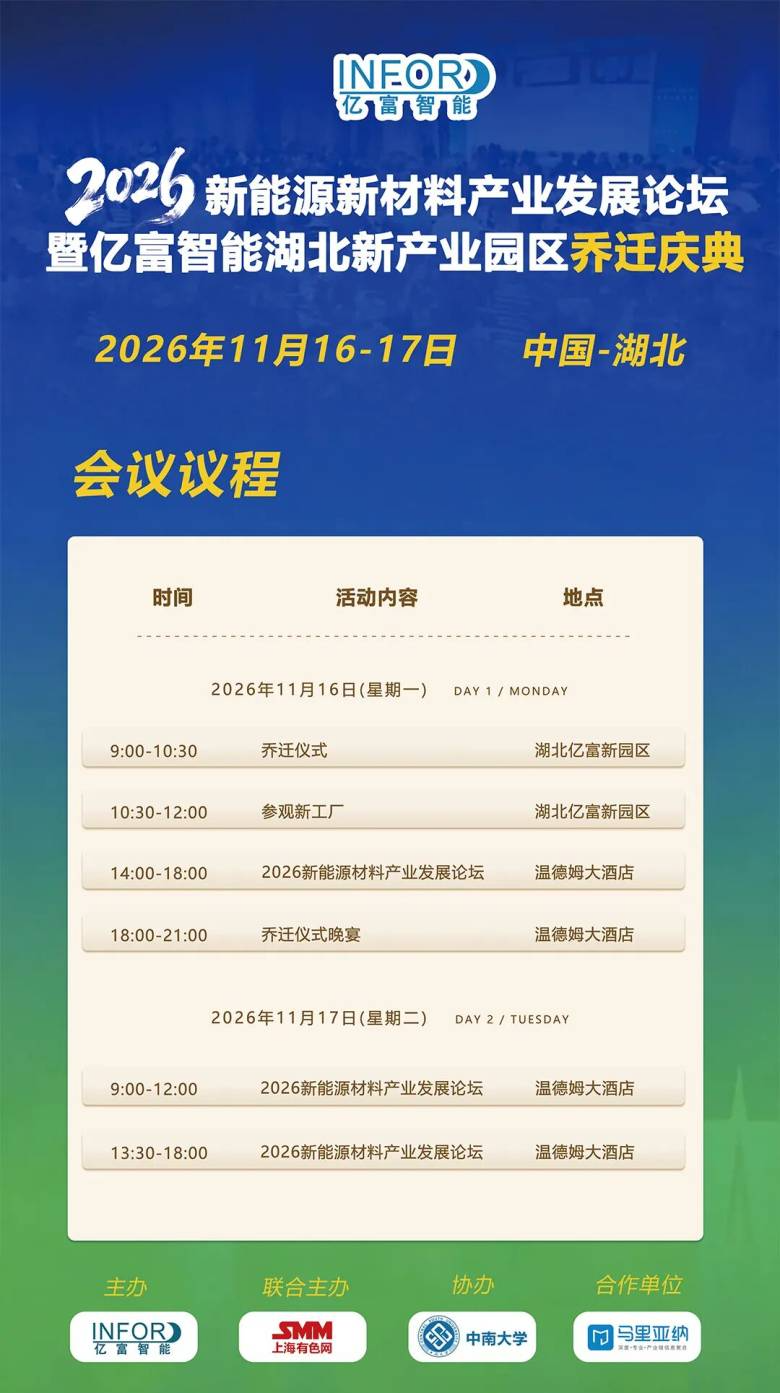
November 16-17, 2026, Gucheng, Xiangyang, Hubei.
On the day of the celebration of the Yifu Intelligent Hubei New Industrial Park, the forum's vision extended from the East Asia production capacity image to the north - when Russia's new energy is simultaneously testing several lines of "local material systems, extreme cold conditions batteries, aluminum electricity and energy storage self-sufficiency", the industry needs an observer who understands the bottom layer of electrochemistry and has seen the difficulties in implementing heavy industrial materials.
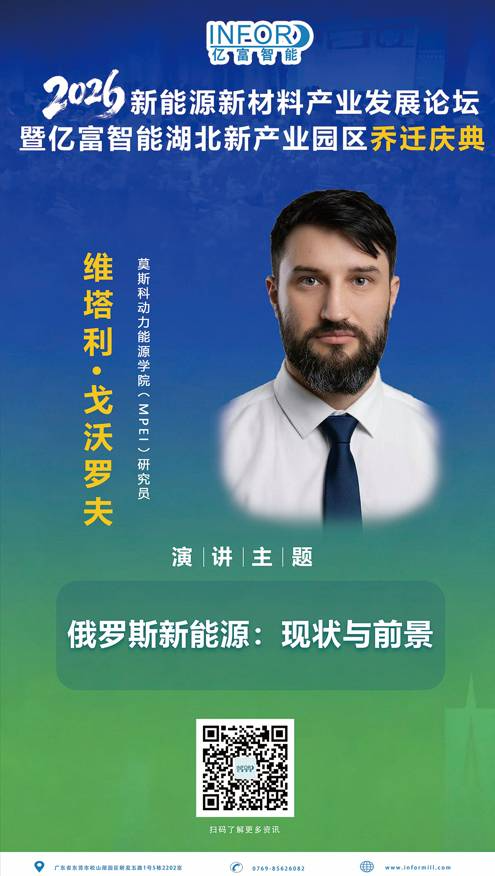
In this round of inter-embedded nodes of the Eurasian battery industry chain, we invited a scholar-type researcher who spans the Department of Chemistry of Moscow State University, the Antwerp Electron Diffraction Center and the engineering site of RUSAL—Vitaly Govorov of the Moscow Power Energy Institute (MPEI). He officially confirmed to attend this forum and the moving celebration of Yifu Intelligent Hubei New Industrial Park, and will bring a keynote report"Russian New Energy: Current Situation and Prospects". From the low-temperature scene in Siberia to the local LFP/polymer electrolyte pilot test, he will explain clearly "what is there, what is missing, and where are the opportunities" in the Russian battery industry.
Russian materials expert who integrates "chemistry, nanometer and energy systems"
Vitaly Govorov graduated from the Chemistry Department of Moscow State University. He studied at the Electron Diffraction and Microscopy Center (EMAT) of the University of Antwerp in Belgium, and has long been deeply involved in inorganic crystal chemistry, electrochemistry and nanomaterial engineering.In his early days in the RUSAL system, he participated in the new material projects of aluminum electrolytic inert anodes, tin-based ceramic anodes and wet cathodes, and understood the industrial logic of "electrolysis conditions - crystal growth - electrode life" thoroughly. Later, he entered the "New Energy Project" section of the National Innovation Company, doing polymer fuel cell simulation, solar cell high-purity silicon process modeling, and systematically studied nano-tin oxide spray pyrolysis, supercritical hydrothermal synthesis and nanomilling dispersion stability.
In the MPEI stage, his research further focused on the core carrier of new energy: composite polymer electrolyte, dielectric behavior of TiO₂/PVDF system, thin film electrode coating and high solid dispersion rheology. Relevant results can be found in multiple collaborative papers on polymer electrolytes, solid-state battery interfaces, and stability of nanodispersed systems. He is not a pure theorist, nor is he a pure equipment dealer - he is used to looking at "how to grind powder stably, how to form a film on slurry, and how to withstand cold temperatures in batteries". This happens to be the overall perspective that Russia's new energy sources lack the most.
In-depth echo with the theme of the forum "New Energy and New Materials"
Govorov's report "Russian New Energy: Current Situation and Prospects"", which just brings the main axis of this forum "New Materials - New Equipment - New Regional Markets" to the Russian context:
The report will be broken down into three layers: Material layer - Russia does not lack lithium, nickel, aluminum and phosphorus resources, but lacks highly consistent precursor processes; LFP localization, polyanion systems, and solid polymer electrolytes are three realistic paths to bypass high nickel dependence. Equipment layer - Batteries in extremely cold areas must resist low temperature, resist lithium precipitation, and resist interfacial polarization, which puts forward more stringent requirements for powder dispersion uniformity, pole piece coating defect rate, and polymer membrane ionic conductivity; traditional horizontal mills and intermittent dispersion are exposed to batch fluctuations under cold area working conditions. Regional level - After the geopolitical restructuring of Russia and Ukraine, Russian car companies, energy storage and military industry scenarios have placed more emphasis on "independent controllability". Chinese equipment + Russian scenario verification is moving from trade to joint pilot testing.
For materials factories, it answers "Which type of cathode should be chosen for batteries in cold regions?"; for equipment factories, it reminds equipment to have low-temperature process packages and remote operation and maintenance; for companies like Yifu, it means that vertical sand grinding, nano-dispersion and continuous pulping systems have the opportunity to enter Europe-Asia cross-border projects along with LFP/solid-state pilot lines. Russia’s opportunity is not to copy China’s production capacity, but to use its resource endowment to rearrange material priorities.
In the golden autumn of November, Gucheng’s new garden opens
From November 16th to 17th, the new park and forum were opened simultaneously in Gucheng, Xiangyang, Hubei! It is recommended that all friends who are engaged in maritime, solid electrolyte, cold area energy storage and Sino-Russian materials cooperation reserve their seats: listen to Govorov clearly explain "the real gap in Russia's new energy and the entry angle of China's industrial chain" from the perspective of Moscow; and also see how Yifu's new production line uses high-precision dispersion to catch the process rhythm of composite electrolytes and extreme cold scenes. The move is not about cutting the ribbon, but about Russian researchers like Yifu and MPEI working together to smooth out the closed loop of Eurasian batteries.
Billion starts a new journey, a rich future, Gucheng New Park will see you there!
2026 New Energy and New Materials Industry Development Forum and Yifu Intelligent Hubei New Industrial Park Moving Celebration
Time:November 16-17, 2026 | Location: Gucheng, Xiangyang, Hubei, China
Speaker:Vitaly Govorov (expert in materials and electrochemistry, MPEI, Moscow Power Energy Institute)
Speech Topic:"Russian New Energy: Current Situation and Prospects"
Sponsor:Yifu Intelligent
Co-organizer:Shanghai Nonferrous Network
Co-organizer:Central South University
Support:Gucheng County People's Government

 English
 亿富机械
 +86-0769-85626082
 541476175@qq.com
 东莞市大岭山镇颜屋村莲颜路88号