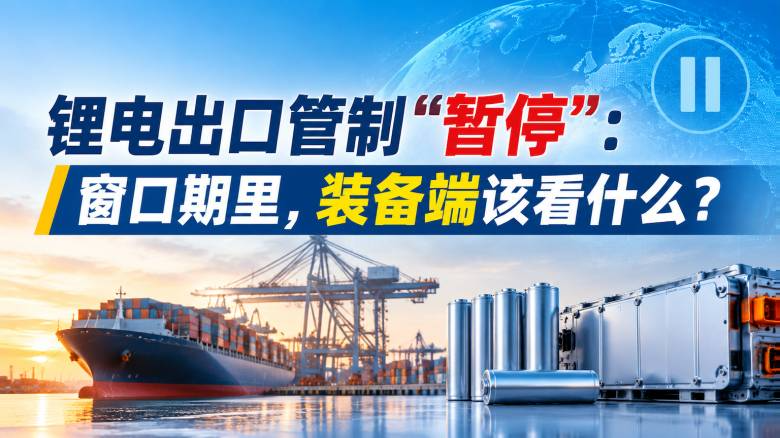
On November 9, the Ministry of Commerce and the General Administration of Customs jointly issued Announcement No. 58 of 2026: From November 11, 2026 to January 10, 2027, a number of previous export control measures involving the lithium battery industry chain will continue to be suspended.
This means that high-energy-density lithium batteries, high-pressure lithium iron phosphate cathode materials, artificial graphite anode materials, as well as manufacturing equipment and technologies such as winding, lamination, liquid injection, and grinding do not need to apply for licenses item by item for the time being, and can be declared smoothly according to general trade procedures.
For the industry, this is not a simple "relaxation", but a window to observe China's lithium battery global competitiveness and equipment independence capabilities. Control can be temporarily suspended, but the truly irreplaceable background of China's lithium batteries is the systematic advantage accumulated over a long period of time in terms of material technology and equipment engineering capabilities.
01
Policies are loosened and the signal is clear
From a macro perspective, this suspension continues the relaxed tone of Sino-US economic and trade negotiations, giving the lithium battery industry chain a window of certainty of about two months.
China's power battery and energy storage battery production and sales account for more than 60% of the world's production and sales. Overseas customers' orders for intensive stocking at the end of the year can be delivered efficiently, and supply chain uncertainty has significantly reduced. However, suspension does not mean cancellation. The policy after January 10, 2027 will still depend on subsequent negotiations and geographical variables.
For smart equipment companies, the real issue is not to rush for a wave of shipments during the window period, but to use this buffer to further consolidate the production line rhythm, overseas compliance, and localized service capabilities - because the next round of global competition is "Stable startup despite policy fluctuations"reliability.
02
Highly compacted iron lithium welcomes opportunities
Zooming in on the cathode material, the most direct beneficiary during the window period isHighly compacted lithium iron phosphate. Currently, the main focus of the industry's production expansion has turned to fourth-generation and above high-compaction products, with the target compaction density breaking through from 2.4 to 2.6 or even 2.7g/cm³. However, the nominal production capacity is sufficient and the effective production capacity that can stably mass-produce high-end products is still tightly balanced.

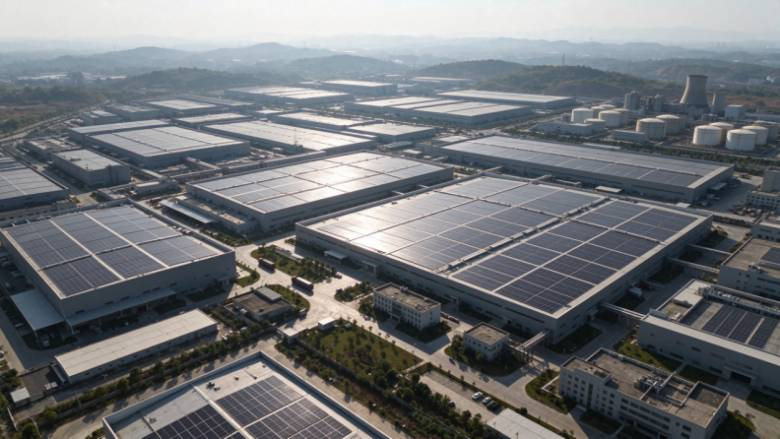
▲ Aerial photography of a lithium battery production base. The roof of the factory is covered with distributed photovoltaics. In addition to the scale of production capacity, what has been long-termly chosen by global customers is the system capability to connect materials, production lines and energy management.
After the simplification of export licenses, the fulfillment rate of overseas long-term agreements has increased. Companies do not have to rush to move production lines abroad. Instead, they can calm down and solidify the closed-loop process of domestic bases. andThe essence of high-pressure competition is to retreat from "formula innovation" to "process reproducibility"——The same formula is produced differently in different production lines, and the difference is often stuck in the front-end grinding section.
03
Grind it into a core and win evenly
This is exactly what the sand mill is going to be from "auxiliary equipment""Core process equipment"Reason:
In the secondary grinding and burning route of lithium iron phosphate, the first sand grinding is responsible for the refinement and mixing of the precursor, and the second sand grinding is responsible for the narrowing of particle size gradation and distribution; the primary particle size, span value, solid content, and temperature rise control directly affect the compaction density and rate performance after sintering.

Uniform dispersion at the nanometer level is not enough to "grind the particles finer", but to allow coarse and fine particles to coexist in a reasonable proportion and reduce the porosity. As the industry rushes towards a compaction density above 2.65, the role of the sand mill becomes a ceiling setter for material performance——It does not appear in the final battery, but is hidden in the uniformity of every powder。
In the longer term, the window period will pass, but the equipment capability must remain.
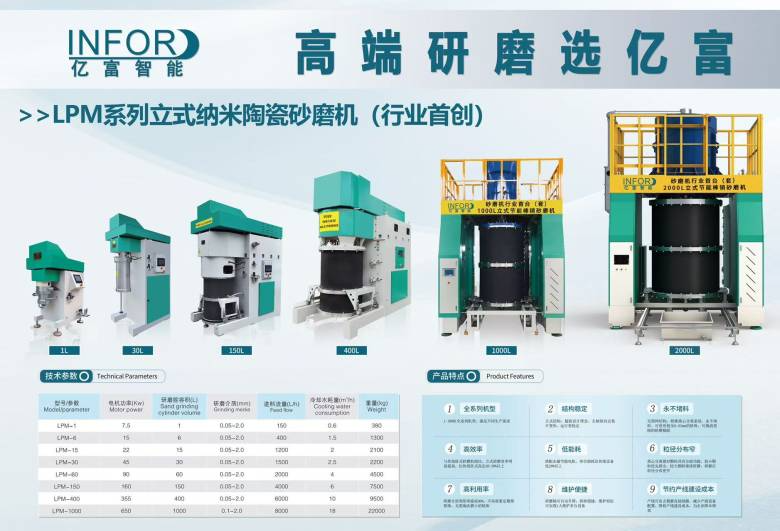
Domestic sand mills have completed the transition from import substitution to large-scale delivery in the past ten years. The next step is the system-level competition of "understanding materials": direct drive transmission, vertical high-energy density cavity, online particle size monitoring, energy consumption traceability, overseas CE certification and spare parts network. These are the real thresholds binding head material factories.
When China's smart equipment goes overseas, it is no longer a matter of quoting a single piece of equipment, but rather a process package output along with customers of lithium iron phosphate, silicon carbon anodes, and solid electrolytes. The policy will change, but"Grind the same batch of materials repeatedly to produce exactly the same distribution."This kind of industrial capacity is the barrier that will not be removed.
Back to the news itself, the window period will pass and industrial upgrading will not stop.
The export control suspension is like pressing a deep breath button for the industry.For material factories, it is an opportunity to stabilize orders, inspect and coordinate, and adjust layout; for equipment factories, it is an opportunity to integrate process understanding into steel and control systems.

We prefer to regard this period of time as a stress test: when the gate is closed again, can China's lithium battery continue to be chosen by global customers with its finer particle size, more stable production line, and deeper equipment foundation? The sand mill is small;But it is ground evenly and stably,It is precisely the part of an industry that is least likely to be copied.

On November 9, the Ministry of Commerce and the General Administration of Customs jointly issued Announcement No. 58 of 2026: From November 11, 2026 to January 10, 2027, a number of previous export control measures involving the lithium battery industry chain will continue to be suspended.
This means that high-energy-density lithium batteries, high-pressure lithium iron phosphate cathode materials, artificial graphite anode materials, as well as manufacturing equipment and technologies such as winding, lamination, liquid injection, and grinding do not need to apply for licenses item by item for the time being, and can be declared smoothly according to general trade procedures.
For the industry, this is not a simple "relaxation", but a window to observe China's lithium battery global competitiveness and equipment independence capabilities. Control can be temporarily suspended, but the truly irreplaceable background of China's lithium batteries is the systematic advantage accumulated over a long period of time in terms of material technology and equipment engineering capabilities.
01
Policies are loosened and the signal is clear
From a macro perspective, this suspension continues the relaxed tone of Sino-US economic and trade negotiations, giving the lithium battery industry chain a window of certainty of about two months.
China's power battery and energy storage battery production and sales account for more than 60% of the world's production and sales. Overseas customers' orders for intensive stocking at the end of the year can be delivered efficiently, and supply chain uncertainty has significantly reduced. However, suspension does not mean cancellation. The policy after January 10, 2027 will still depend on subsequent negotiations and geographical variables.
For smart equipment companies, the real issue is not to rush for a wave of shipments during the window period, but to use this buffer to further consolidate the production line rhythm, overseas compliance, and localized service capabilities - because the next round of global competition is "Stable startup despite policy fluctuations"reliability.
02
Highly compacted iron lithium welcomes opportunities
Zooming in on the cathode material, the most direct beneficiary during the window period isHighly compacted lithium iron phosphate. Currently, the main focus of the industry's production expansion has turned to fourth-generation and above high-compaction products, with the target compaction density breaking through from 2.4 to 2.6 or even 2.7g/cm³. However, the nominal production capacity is sufficient and the effective production capacity that can stably mass-produce high-end products is still tightly balanced.

▲ Aerial photography of a lithium battery production base. The roof of the factory is covered with distributed photovoltaics. In addition to the scale of production capacity, what has been long-termly chosen by global customers is the system capability to connect materials, production lines and energy management.
After the simplification of export licenses, the fulfillment rate of overseas long-term agreements has increased. Companies do not have to rush to move production lines abroad. Instead, they can calm down and solidify the closed-loop process of domestic bases. andThe essence of high-pressure competition is to retreat from "formula innovation" to "process reproducibility"——The same formula is produced differently in different production lines, and the difference is often stuck in the front-end grinding section.
03
Grind it into a core and win evenly
This is exactly what the sand mill is going to be from "auxiliary equipment""Core process equipment"Reason:
In the secondary grinding and burning route of lithium iron phosphate, the first sand grinding is responsible for the refinement and mixing of the precursor, and the second sand grinding is responsible for the narrowing of particle size gradation and distribution; the primary particle size, span value, solid content, and temperature rise control directly affect the compaction density and rate performance after sintering.

Uniform dispersion at the nanometer level is not enough to "grind the particles finer", but to allow coarse and fine particles to coexist in a reasonable proportion and reduce the porosity. As the industry rushes towards a compaction density above 2.65, the role of the sand mill becomes a ceiling setter for material performance——It does not appear in the final battery, but is hidden in the uniformity of every powder。
In the longer term, the window period will pass, but the equipment capability must remain.
Domestic sand mills have completed the transition from import substitution to large-scale delivery in the past ten years. The next step is the system-level competition of "understanding materials": direct drive transmission, vertical high-energy density cavity, online particle size monitoring, energy consumption traceability, overseas CE certification and spare parts network. These are the real thresholds binding head material factories.
When China's smart equipment goes overseas, it is no longer a matter of quoting a single piece of equipment, but rather a process package output along with customers of lithium iron phosphate, silicon carbon anodes, and solid electrolytes. The policy will change, but"Grind the same batch of materials repeatedly to produce exactly the same distribution."This kind of industrial capacity is the barrier that will not be removed.
Back to the news itself, the window period will pass and industrial upgrading will not stop.
The export control suspension is like pressing a deep breath button for the industry.For material factories, it is an opportunity to stabilize orders, inspect and coordinate, and adjust layout; for equipment factories, it is an opportunity to integrate process understanding into steel and control systems.

We prefer to regard this period of time as a stress test: when the gate is closed again, can China's lithium battery continue to be chosen by global customers with its finer particle size, more stable production line, and deeper equipment foundation? The sand mill is small;But it is ground evenly and stably,It is precisely the part of an industry that is least likely to be copied.