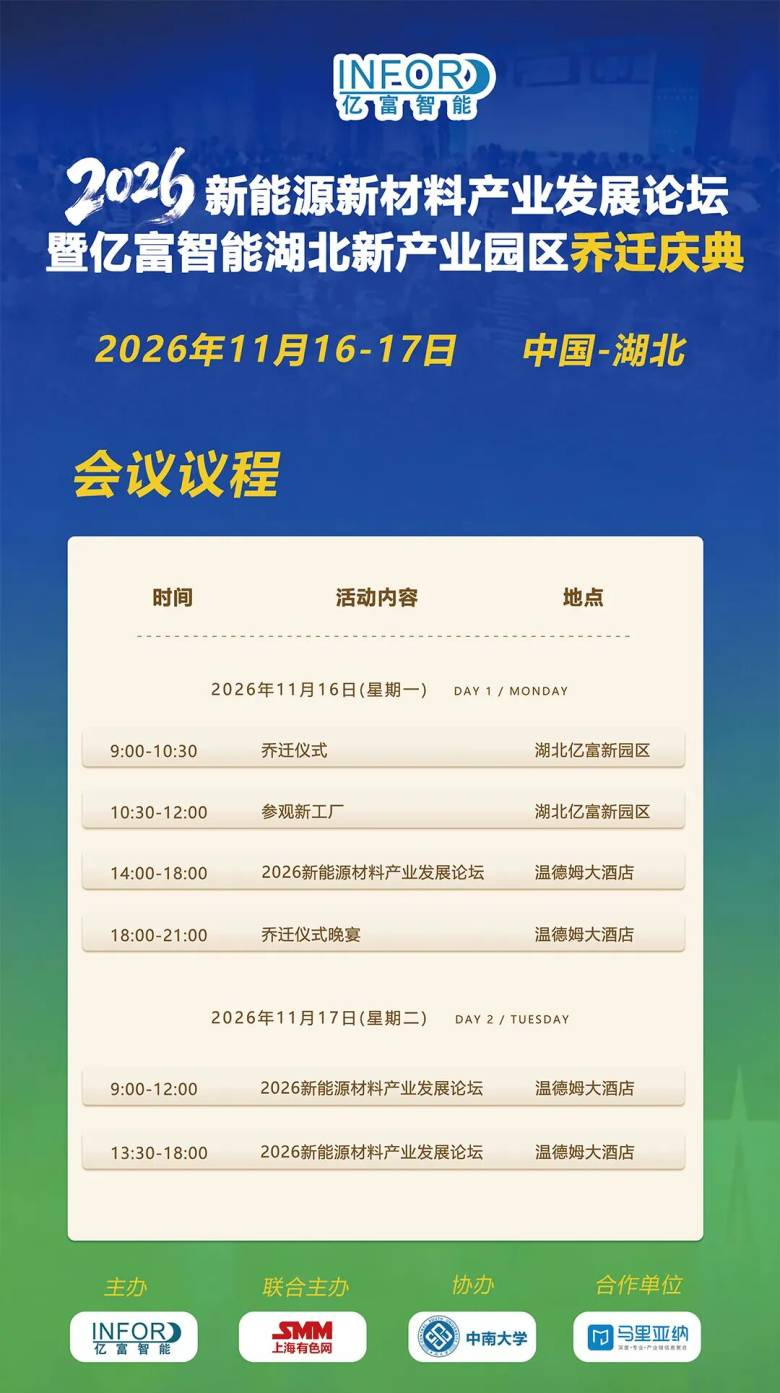
November 16-17, 2026, Gucheng, Xiangyang, Hubei.
Yifu Intelligent Hubei's new industrial park is about to be launched, and the forum topics have also sunk from the main material formula to "how to add each gram of conductive agent to the slurry."
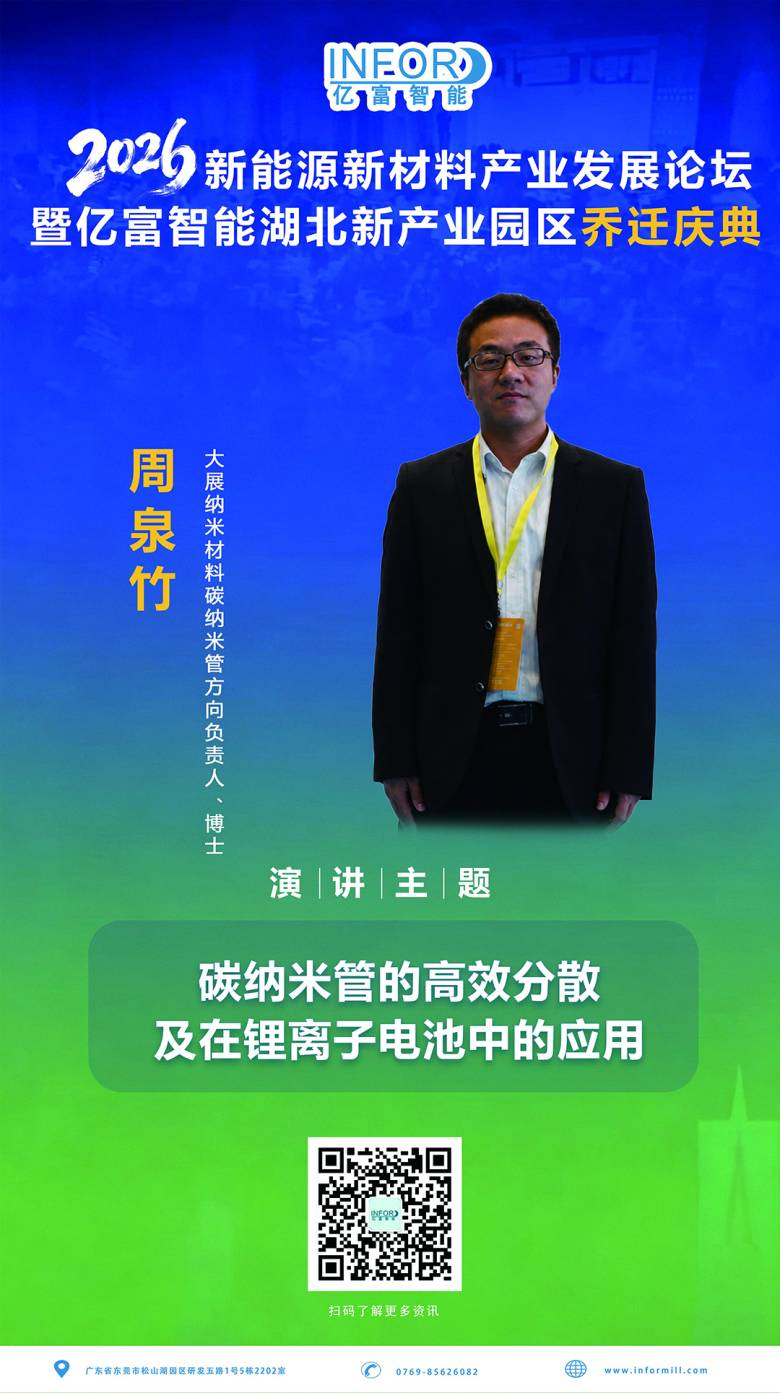
In this tough round of "nanomaterial engineering", we invited a researcher who specializes in dealing with CNT agglomerates - Zhou Quanzhu, a doctor of nanomaterials in Dazhan and the person in charge of carbon nanotube dispersion and application. He confirmed to attend the 2026 New Energy and New Materials Industry Development Forum and the Yifu Intelligent Hubei New Industrial Park Housewarming Celebration, and will bring a keynote report "Efficient Dispersion of Carbon Nanotubes and Application in Lithium-Ion Batteries". From surface modification, slurry viscosity reduction to the three-dimensional conduction network of the electrode piece, he will explain "how to lay a pipe into the electrode" into a process language that the production line supervisor can understand.
The dispersion doctor who transformed carbon nanotubes from "tangled into balls" to "paved into networks"
Dr. Zhou Quanzhu has long been rooted in the front line of carbon nanomaterial engineering. His research directions focus on carbon nanotube purification, end cap modification, liquid phase dispersion and lithium conductive slurry formulation coupling.As a pioneer in the industrialization of carbon nanotubes in China, Dazhan Nano has a kiloton-level continuous production line for multi-walled carbon nanotubes, and undertakes key research tasks such as major scientific and technological projects in Shandong Province and the stable preparation of single-walled carbon nanotubes. Its "green modification + special dispersion equipment" route reduces the dispersion cost to about 40% of that of foreign solutions.
In the technical link Zhou Quanzhu participated in, the team developed a collaborative process of low-damage oxidation, silane end cap modification and high-shear grinding around the three elements of "breaking up agglomerates - cutting long tubes - maintaining a single state". The supporting NMP-based conductive slurry has a fineness of ≤10μm and a stable and controllable viscosity. Samples have been sent to power LFP, high-nickel NCM and silicon-carbon anode customers for verification. Relevant achievements are reflected in Dazhan Nano's multiple CNT modification and slurry patents, which solve the dilemma of traditional strong acid purification with high pollution and ultrasonic dispersion with difficult volume. He himself has repeatedly emphasized in internal technical exchanges that dispersion is not an auxiliary process, but a switch in the conductive contribution rate of CNTs.
In-depth echo with the theme of the forum "New Energy and New Materials"
Zhou Quanzhu's report"Efficient dispersion of carbon nanotubes and its application in lithium-ion batteries",It just makes up for the lesson of this forum that "new materials must pass the equipment test".
The report is divided into two production line logics: the material side, why van der Waals force + π-π stacking causes the carbon tube to form cotton in NMP; the process side, how the end cap modification retains the conductivity of the tube body and adds a compatibility layer to the surface. Moving on to the battery core scenario - thick electrodes, fast charging, and silicon anode expansion buffers, these three types of structures all put forward higher requirements for the three-dimensional conduction network, and the quality of the network does not depend on how much CNT is added, but on whether each tube is released individually.
For the cathode factory, it gives the formula boundary of "low addition, high conduction"; for the cell process, it reminds that the stirring time, linear speed, and grinding medium ratio will directly rewrite the resistance of the electrode piece; for equipment companies such as Yifu, it means that the sand mill is no longer a supporting role, but the first gate that determines whether CNT slurry can move from the laboratory gram level to the ton level.
In the golden autumn of November, Gucheng’s new garden opens
From November 16th to 17th, the new park and forum opened simultaneously in Gucheng, Xiangyang, Hubei. Let's listen to Mr. Zhou Quanzhu explain the mechanism of CNT dispersion, equipment parameters and failure cases, and also see how Yifu's new production line uses stabilized grinding to turn "single conduction" from paper diagrams into batch data. Moving is not a new starting point. It is front-line material people like Yifu and Dazhan Nano who work together to smooth the capillaries in the lithium electrode sheet.
Billion starts a new journey, a rich future, Gucheng New Park will see you there!
2026 New Energy and New Materials Industry Development Forum and Yifu Intelligent Hubei New Industrial Park Moving Celebration
Time:November 16-17, 2026 | Location: Gucheng, Xiangyang, Hubei, China
Speaker:Dr. Zhou Quanzhu (Director of Carbon Nanotube Dispersion and Application of Dazhan Nanomaterials)
Speech Topic:"Efficient Dispersion of Carbon Nanotubes and Application in Lithium-ion Batteries"
Sponsor:Yifu Intelligent
Co-organizer:Shanghai Nonferrous Network
Co-organizer:Central South University
Support:Gucheng County People's Government
 English

 亿富机械
 +86-0769-85626082
 541476175@qq.com
 东莞市大岭山镇颜屋村莲颜路88号