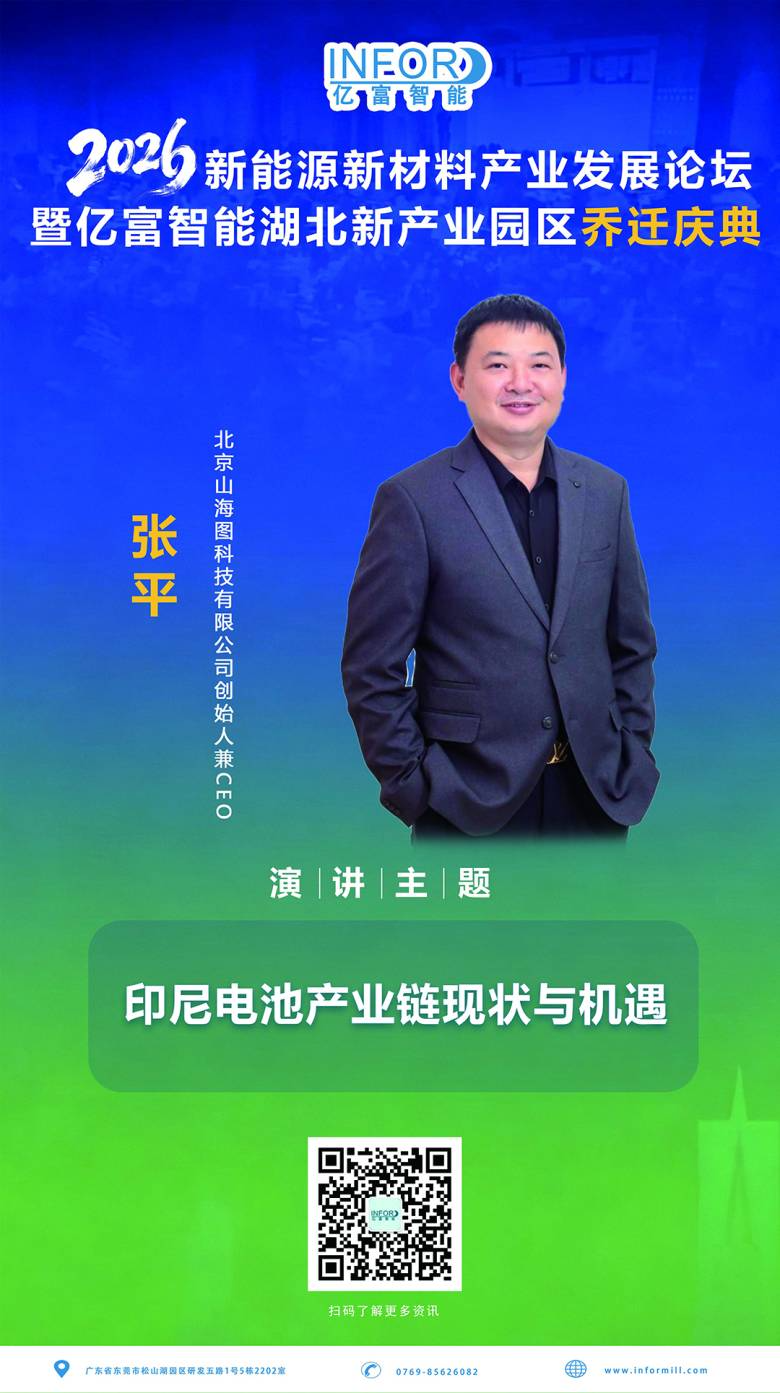
November 16-17, 2026, Gucheng, Xiangyang, Hubei.
On the day of the celebration of Yifu Intelligent Hubei New Industrial Park, the forum's vision shifted from "domestic roll production capacity" to "overseas construction ecology". When China's battery industry chain collectively moves south to the equator, Indonesia is no longer just a "nickel archipelago", but the busiest construction site in the middle reaches of the world's power batteries - laterite nickel mines, hydrosmelting, precursors, LFP, and battery packs are being rearranged on a park-by-park basis.
At the forefront of this wave of Chinese companies going global, we invited a guide who is based in Southeast Asia and has stepped into the mud of Indonesian industrial parks - Mr. Zhang Ping, founder and CEO of Beijing Shanhaitu Technology Co., Ltd. He started his business in 2013 and switched to the overseas business track in 2018. He has been deeply involved in the Indonesian and Southeast Asian markets for many years. He has officially confirmed that he will attend this forum and the housewarming celebration of Yifu Intelligent Hubei New Industrial Park, and will give a keynote report"Current Status and Opportunities of Indonesia's Battery Industry Chain". From the nickel ore downstream policy to the localization rate of TKDN, he will explain clearly the logic of "going global is not about moving factories, but about rebuilding the supply chain."
From engineer to "navigator for Chinese enterprises to go overseas in Indonesia"
Mr. Zhang Ping is an engineer by training. He founded Shanhaitu in Beijing in 2013. In 2018, he moved the main battlefield to Jakarta, Indonesia. Starting from company registration, finance and taxation, visas, and qualifications, he gradually developed into a one-stop overseas service platform covering "site inspection, factory licensing, product certification, legal and environmental protection". He is not a scholar who sits in his study and writes reports, but a practical person who stays in Indonesia for more than 300 days every year, accompanying clients to visit industrial parks, look at land plots, and pay attention to environmental impact assessments.
He has written more than a hundred professional articles on companies going overseas, and has repeatedly lectured on the Indonesian new energy market at large domestic and foreign events such as the CLNB New Energy Industry Expo and the Indonesian Power Battery Summit. His service customers cover more than 3,500 well-known companies such as Huawei, Sany Heavy Industry, ZTE, CATL, BYD, Huayou Cobalt, Longpan, Hailiang, COMAC, Shanghai Electric, etc. The Shanhaitu team has provided localized services in 14 cities in 7 countries including Jakarta, Surabaya, Medan, Semarang, Vietnam, Thailand, and Malay in Indonesia. Recently, it has obtained the Indonesian LPJP environmental assessment qualification, becoming the first Chinese-funded consulting agency in Indonesia to obtain this qualification. What he knows best is translating "Chinese production capacity" into "Indonesian compliance projects."
In-depth echo with the theme of the forum "New Energy and New Materials"
Mr. Zhang Ping's report"Current Status and Opportunities of Indonesia's Battery Industry Chain" just brings the main axis of this forum "New Materials - New Equipment - New Globalization" to Southeast Asia:
The report will break down three layers of real business formats: the resource layer - Indonesia's nickel reserves account for about 41.9% of the world, but the upstream good mines have been controlled by super giants, and the hydrosmelting capacity is in periodic excess. The window for simply "buying mines and building factories" is closed; the midstream layer - opportunities are concentrated in cathode precursors, LFP, copper foil, electrolytes, separators and PACK: Huayou, Longpan, and Hailiang have been implemented, and CATL's 15GWh battery cell project is in progress. After LG partially withdraws, Chinese companies will take over; the rule layer - TKDN localization rate, quota from the Ministry of Energy and Mines, environmental impact assessment LPJP, and PPA power purchase agreement, determines whether the project can be started and whether the product can be exported.
For the material factory, it answered "Which section is the most cost-effective to build in Indonesia?"; for the equipment factory, it reminded that the park is not a copy of the domestic workshop, and powder transportation, water and electricity prices, and local maintenance capabilities must be recalculated; for companies like Yifu, this means that when going overseas, grinding, dispersing, and pulping production lines cannot just sell equipment, but must also bring process packages, operation and maintenance, and local training. Indonesia’s opportunity lies not in “cheaper factories” but in “rebuilding the battery supply chain with local rules.”
In the golden autumn of November, Gucheng’s new garden opens
With the opening of the new park in Gucheng, Yifu Intelligent has moved a new generation of grinding, dispersing and continuous pulping production lines to central China. On the surface, it is expanding production, but on the deep side, it is preparing sample rooms for "equipment going overseas" - when the parks in Central Sulawesi and North Kalimantan, Indonesia, began to call for "consistency with the same models in China", the process data, dielectric loss curves and remote diagnosis capabilities of the front-end equipment are the delivery language for going overseas.
From November 16th to 17th, the new park and forum opened simultaneously in Gucheng, Xiangyang, Hubei. It is recommended that all friends who are engaged in overseas manufacturing, nickel-based materials, LFP overseas factory construction, park supporting facilities and cross-border compliance, reserve their seats: listen to Zhang Ping explain clearly from the perspective of Jakarta "Where is the Indonesian battery chain going now, where will the pitfalls be next, and how will Chinese equipment follow?"; also see how Yifu's new production line uses a replicable process base to catch the mass production pace of Southeast Asian parks. Relocation is not a ribbon-cutting, but a first-line overseas service provider like Yifu and Shanhaitu, working together to smooth the "second home" of China's battery industry chain.
Billion starts a new journey, a rich future, Gucheng New Park will see you there!
2026 New Energy and New Materials Industry Development Forum and Yifu Intelligent Hubei New Industrial Park Moving Celebration
Time:November 16-17, 2026 | Location: Gucheng, Xiangyang, Hubei, China
Speaker:Zhang Ping (Founder and CEO of Beijing Shanhaitu Technology Co., Ltd.)
Speech Topic:"Current Status and Opportunities of Indonesia's Battery Industry Chain"
Sponsor:Yifu Intelligent
Co-organizer:Shanghai Nonferrous Network
Co-organizer:Central South University
Support:Gucheng County People's Government
 English
 亿富机械
 +86-0769-85626082
 541476175@qq.com
 东莞市大岭山镇颜屋村莲颜路88号