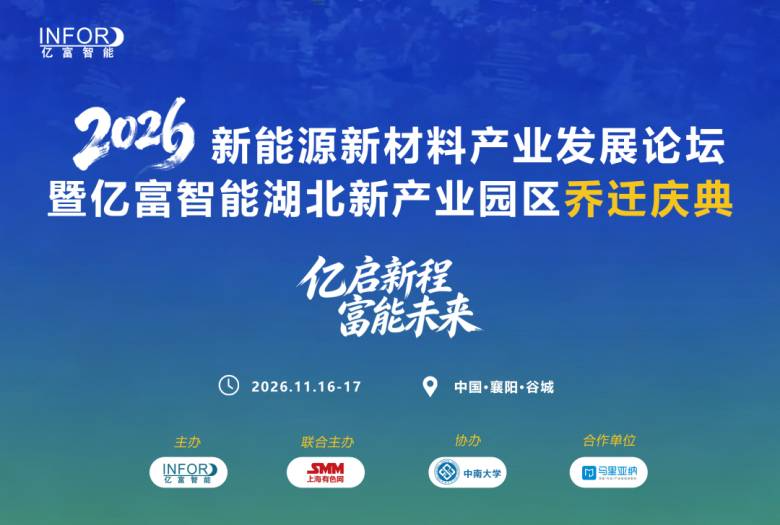
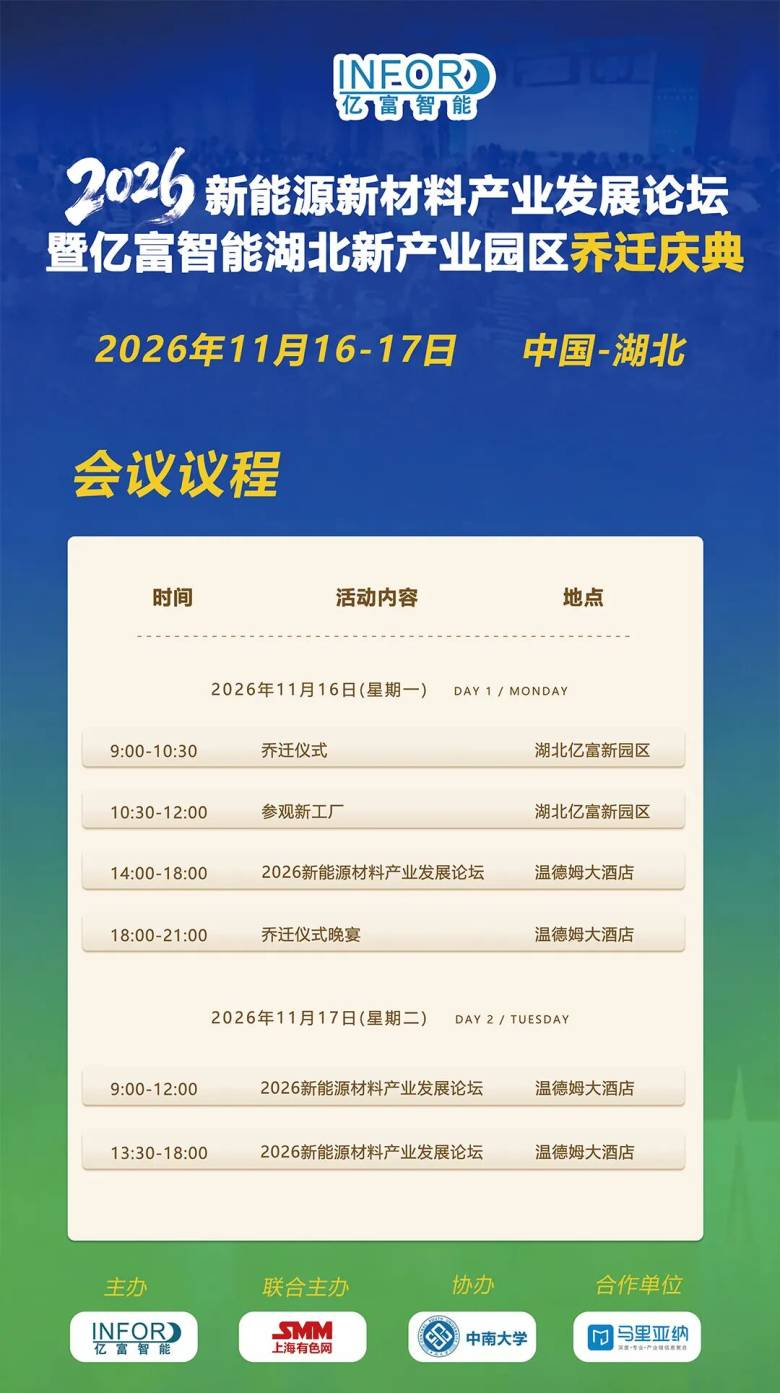
November 16-17, 2026, Gucheng, Xiangyang, Hubei.
With the opening of Yifu Intelligent Hubei New Industrial Park, the forum will shift the lens from the main materials of positive and negative electrodes to the conductive network in the electrode piece, which accounts for less than 1% but determines magnification and yield.
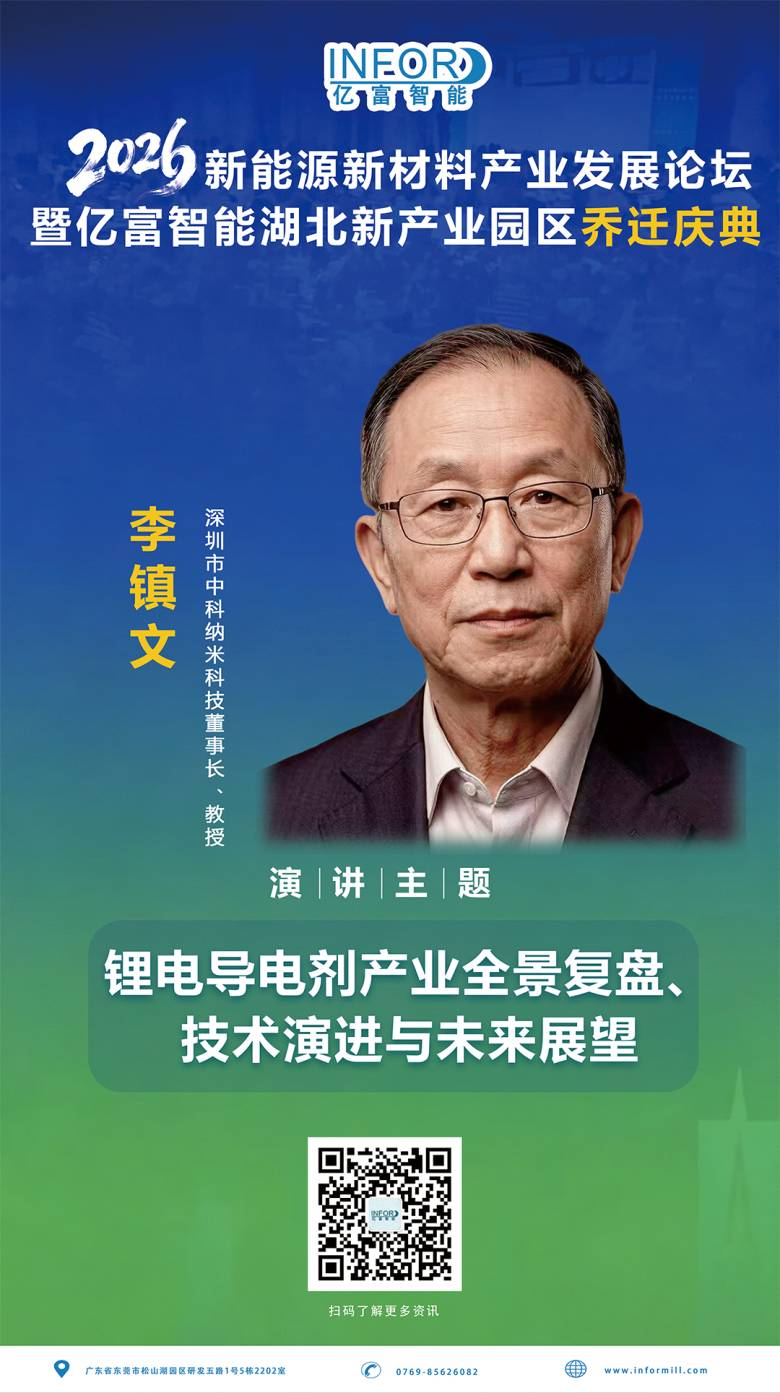
At this critical juncture of "nanomaterial engineering", we invited a pioneer who really pulled carbon nanotubes from Chinese papers into mass production lines - Professor Li Zhenwen. He graduated from the Department of Chemistry of Jilin University in his early years and has long been engaged in catalytic chemistry research at the Changchun Institute of Applied Chemistry, Chinese Academy of Sciences. In 2001, he participated in the establishment of my country's first carbon nanotube production company, Shenzhen Nanoport Co., Ltd., and served as general manager and chief scientist. This time he confirmed to attend the 2026 New Energy and New Materials Industry Development Forum and the Yifu Intelligent Hubei New Industrial Park Relocation Celebration, and delivered a keynote report"Panorama Review of Lithium Electric Conductive Agent Industry, Technology Evolution and Future Prospects" explains the twenty-year cycle, formula and equipment dependence of conductive agents in one go.
One of the pioneers of carbon nanotube preparation and application technology in China
Professor Li Zhenwen has a very solid “catalysis + nano” dual background:The foundation was laid in the Department of Chemistry of Jilin University, and he has been doing catalytic chemistry at the Changchun Institute of Applied Chemistry of the Chinese Academy of Sciences for many years, which allowed him to understand the mechanisms of pipe diameter, chirality and aspect ratio, and also calculate the catalyst loss in ton-level production lines.
In 2001, he co-founded Shenzhen Nanoport Co., Ltd., my country's first and one of the world's earliest carbon nanotube production companies, and served as general manager and chief scientist. Since then, he has presided over the formulation of my country's first national standard for carbon nanotubes, giving the industry a unified purity and structure scale for the first time; he has presided over the completion of the national 863 project "Preparation of electrostatically conductive coatings for oil storage tanks", extending carbon nanotubes from lithium battery rings to heavy anti-corrosion scenarios; he proposed the original "shear conjugation theory", opening up the dead ends of carbon nanotube dispersion in solutions and slurries in one fell swoop, and is regarded by the industry as the key to the industrial application of CNTs.
He also developed dozens of high-efficiency carbon nanotube catalysts. The carbon nanotube production equipment he designed was exported to companies such as Japan and North Korea, and he brought the first batch of technical backbones to my country's carbon nanotube industry. Since 2012, he has been a senior technical consultant of the Beijing Institute of New Materials and New Technology Industrialization. In 2016, he founded Shenzhen Zhongke Nanotechnology Co., Ltd. to continue to deepen the downstream applications of carbon nanotubes.
In-depth echo with the theme of the forum "New Energy and New Materials"
Li Zhenwen’s report"Panorama Review of Lithium Electric Conductive Agent Industry, Technology Evolution and Future Prospects", just to make up for the lesson of this forum that "new materials must pass the equipment test".
The report is divided into three lines using his more than 20 years of industrial perspective: panoramic review - how carbon black is replaced by domestic CNT, whether behind each round of overcapacity is catalyst iteration or demand mismatch; technological evolution - from multi-wall expansion to single-wall disruption, from dry From powder premixing to online dispersion slurry, the truth of the switch is hidden in the four words "shear conjugation"; medium and long-term prospects - fast charging, silicon carbon anodes, and solid-state semi-solids put forward higher requirements for three-dimensional conduction networks, and single-wall CNT will change from a high-end option to a necessity for mass production.
For material factories, it provides the pricing logic for the conductive agent to change from auxiliary materials to main materials; for battery core factories, it reminds that the conductive network must be advanced to the cathode formulation stage; for equipment companies such as Yifu, it means that high-shear dispersion, online particle size detection, and anti-agglomeration transportation are no longer supporting processes, but the first gate to whether CNT slurry can be stably released. Li Zhenwen used the "shear conjugation theory" to answer the same question twenty years ago: carbon tubes that cannot be dispersed will become waste no matter how much they are added.
In the golden autumn of November, Gucheng’s new garden opens
In Gucheng New Park, Yifu Intelligent has launched a new generation of high-shear grinding, continuous pulping and online particle size monitoring production lines in central China. In essence, it is to prepare process master machines for "eating and dispersing" systems such as carbon nanotube slurry, high-pressure compacted iron lithium, and polyanion sodium electricity. The next battle in the conductive agent industry is not about whether to add CNTs, but whether the aspect ratio, agglomeration index and viscosity curve of each batch of slurry are controllable.
On November 16th and 17th, in Gucheng, Xiangyang, Hubei, the new park and the forum opened simultaneously. It is recommended that all friends who are engaged in conductive slurry, cathode slurry, fast charging core and equipment integration reserve their seats: listen to Professor Li Zhenwen use the dual perspectives of "the first carbon nanotube national standard setter" and "the shear conjugation theory proposer" to lay out the conductive agent cycle, formula and equipment dependence into a clear map; also see how Yifu's new production line uses high-precision dispersion to catch the process rhythm of single-wall CNT mass production. Billion starts a new journey, a rich future, Gucheng New Park will see you there!
2026 New Energy and New Materials Industry Development Forum and Yifu Intelligent Hubei New Industrial Park Moving Celebration
Time:November 16-17, 2026 | Location: Gucheng, Xiangyang, Hubei, China
Speaker:Professor Li Zhenwen (Founder of Shenzhen Zhongke Nanotechnology Co., Ltd., former Executive Director of Shenzhen Zhongke Nanotechnology Development Co., Ltd.)
Speech Topic:"Panorama Review of Lithium Electric Conductive Agent Industry, Technology Evolution and Future Prospects"
Sponsor:Yifu Intelligent
Co-organizer:Shanghai Nonferrous Network
Co-organizer:Central South University
Support:Gucheng County People's Government
 English
 亿富机械
 +86-0769-85626082
 541476175@qq.com
 东莞市大岭山镇颜屋村莲颜路88号