1. Overview:
Olivine-type lithium iron manganese phosphate has the advantages of high energy density, low cost, safety and stability, and has received widespread attention in lithium-ion batteries. However, the material suffers from low electronic conductivity and manganese dissolution. The article explains the development status of lithium-ion batteries, introduces the structure and performance of lithium manganese iron phosphate, reviews its application process and preparation methods, and finally analyzes its industrial chain application scenarios.
27 W·h/kg, according to its theoretical gram capacity, the current energy density has almost reached the limit, and the voltage platform is an important factor to further increase the energy density. Lithium iron phosphate (LMFP) and lithium iron phosphate (LFP) have similar material structures and equivalent performance. Due to the high voltage characteristics of manganese, LMFP has a higher voltage platform and battery energy density than LFP.
2. Structure of lithium iron manganese phosphate battery:
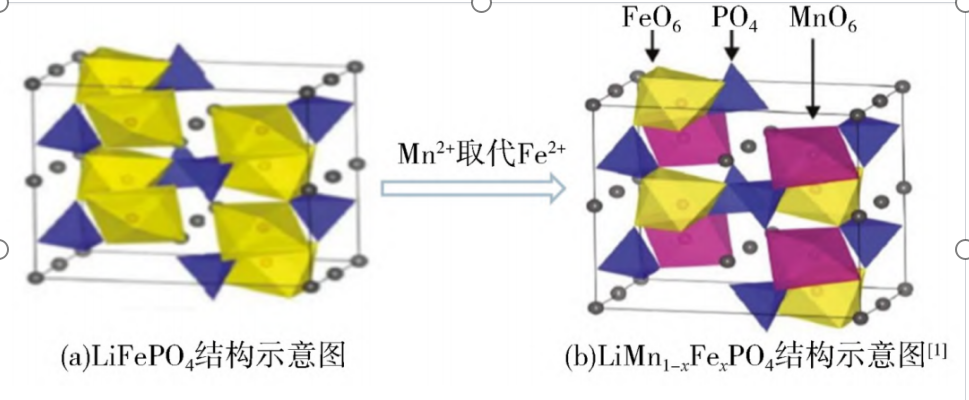
Since Fe2+ and Mn2+ have similar ionic radii and similar physical and chemical properties, replacing Mn with Fe can obtain a stable and uniform solid solution LiMn1-xFexPO4 composed of LiMnPO4 and LiFePO4. LMFP and LFP both have an olivine structure. P atoms form PO4 tetrahedrons through strong covalent bonds with PO. These PO4 tetrahedrons are cross-connected with FeO6 (MnO6) octahedrons, limiting changes in the lattice volume and ensuring corresponding safety and stability. The structure diagram of LiFePO4 is shown in Figure 1(a), and the structure diagram of LiMn1-xFexPO4 is shown in Figure 1(b).
3. Performance advantages and disadvantages of lithium iron manganese phosphate batteries:
The advantages of lithium iron manganese phosphate batteries compared to lithium iron phosphate batteries are:
(1) High energy density, but the theoretical volumes of LMFP and LFP are similar. LMFP has a higher voltage platform, so its energy density is about 10% - 20% higher than LFP;
(2) The budget capability is good at low temperatures. Research shows that at −20°C, the capacity of the Fe platform accounts for about 50% of the capacity of the Fe platform, and the capacity of the Mn platform accounts for 95% of the capacity of the Mn platform;
(3) Safety performance is basically the same.
Disadvantages are:
(1) The conductivity is poor. Lithium iron phosphate is a semiconductor, but after entering the manganese element, the value of the band width is significantly reduced, resulting in LMFP having lower electronic conductivity and lithium ion mobility;
(2) The normal temperature cycle is slightly poor, and the manganese ions are easily eluted and attenuated significantly during high temperature cycles. Due to the Jahn-Teller effect, manganese ions may dissolve during the charge and discharge process, causing side reactions with the sustaining fluid, causing capacity loss.
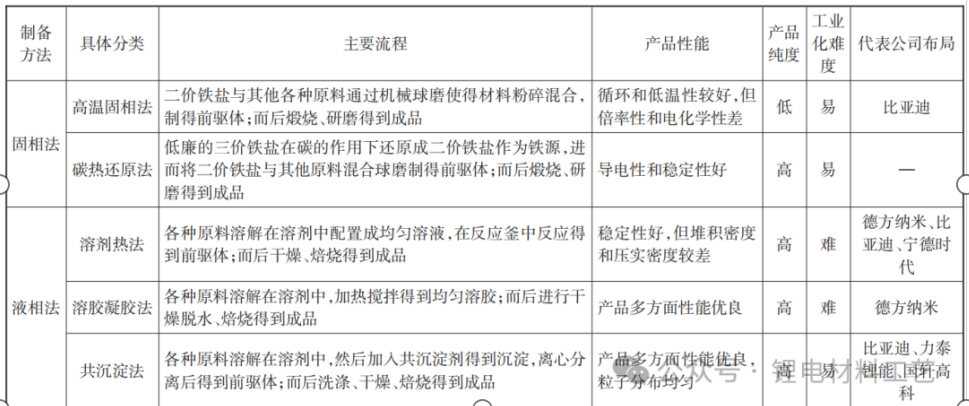
4. Preparation method of lithium iron manganese phosphate LMFP material can be prepared by operating method or solid phase method.
Operation methods include thermal method, sol cement method, etc. The operation method is conducive to the control of corresponding factors and has good product consistency, but the products obtained by this method are compact and dense and require high unit investment. The production line and lithium iron phosphate can be modified similarly. The phase-up method includes high-temperature solid phase method, carbon reduction method, etc., which is easy to achieve large-scale industrialization, has low unit investment and high solid density, but it is difficult to control product consistency and layout distribution. Among them, the solid-phase method and lithium iron phosphate consumes the phosphoric acid sintering equipment in the rear stage, and an additional iron-manganese mixing is required in the front stage. The consistency depends on the level of technology.

 English
 亿富机械
 +86-0769-85626082
 541476175@qq.com
 东莞市大岭山镇颜屋村莲颜路88号