November 16-17, 2026, Gucheng, Xiangyang, Hubei.
On the day of the celebration of Yifu Intelligent Hubei New Industrial Park, the focus of the forum shifted from "what the material can do" to "whether the vehicle can be used and whether users can perceive it." When battery cell performance converges and costs approach the limit, the focus of competition is shifting from Wh unit price to batch consistency, full life cycle security and terminal experience.
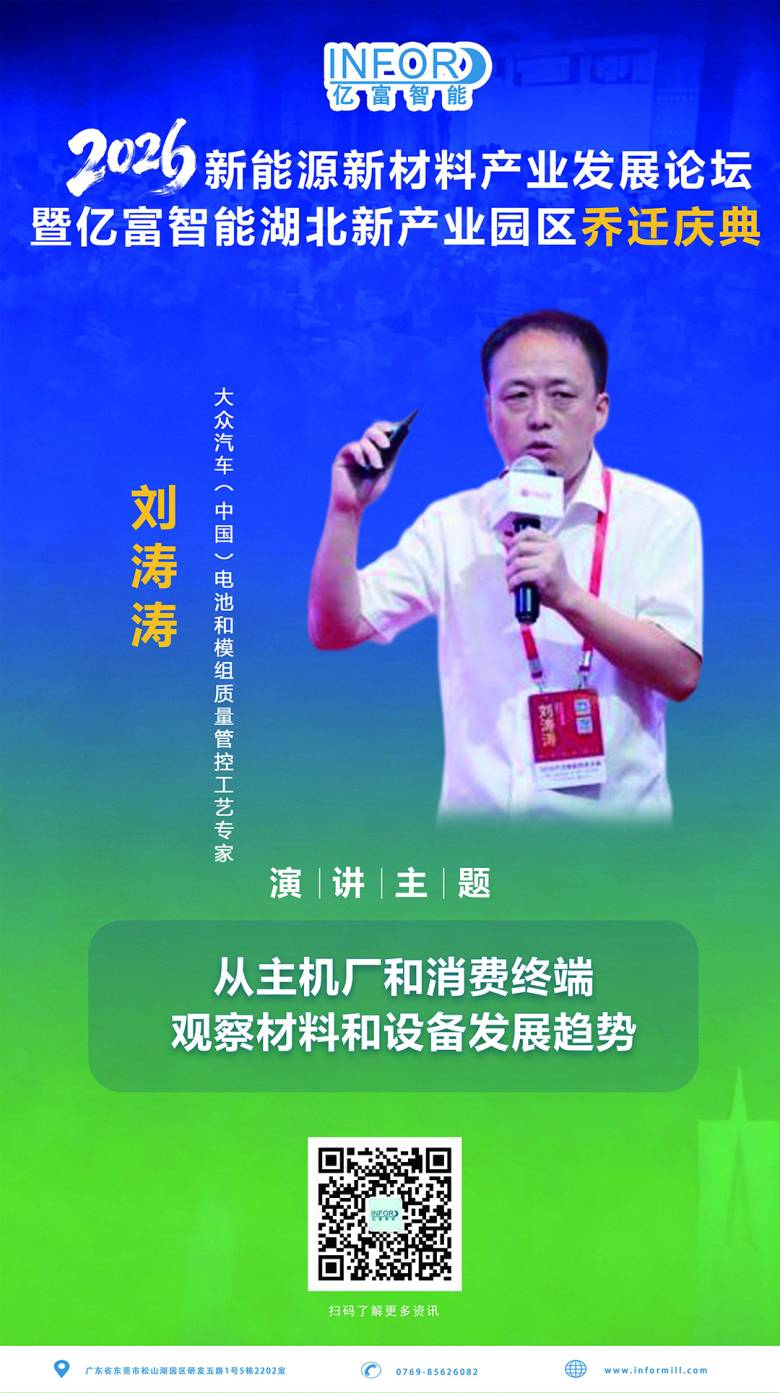
In this round of turning point where "OEMs take back the right to define batteries", we invited a process judge who stands at the intersection of the car end and the battery end - Liu Taotao, battery and module quality control process expert of Volkswagen Group (China). He has long been involved in the definition of power battery types, module process audits and the construction of multi-supplier quality standards. He has officially confirmed to attend this forum and the moving celebration of Yifu Intelligent Hubei New Industrial Park, and will bring a theme report"Observing the Development Trend of Materials and Equipment from OEMs and Consumer Terminals". From users' complaints about low-temperature attenuation and charging anxiety, and deducing where to change the cathode, electrolyte and production lines, he will lay out the "real demand list" of the OEM.
The OEM process expert who wrote "safety and consistency" into the battery cell acceptance criteria
Liu Taotao is currently a battery and module quality control process expert at Volkswagen Group (China). He previously served as Volkswagen battery and module technical manager and was deeply involved in material selection, supplier process audit and module manufacturing quality system construction under the Volkswagen Unified Cell architecture. He is not a person who stands in the lab to prepare the products, but a person who stands on the threshold of vehicle regulations and decides "which battery cell can enter the public and which production line cannot pass the PPM level."
On behalf of Volkswagen, he conducted technical exchanges with Dangsheng Technology and CITIC Metal on niobium-modified high-nickel ternary and lithium iron manganese phosphate/ternary compound systems, and clearly stated that "safety is the first factor in power batteries, and energy density cannot be improved at the expense of manufacturing margins." In his daily work, he extrapolates BMS data, after-sales failure cases, and production line CT/X-ray inspection results back to the material end: pole piece alignment, metal foreign matter, slurry dispersion uniformity, and packaging edge lamination—these micron-level process variables are the real "material indicators" in the eyes of OEMs. This perspective of "tracing back to the process from the terminal" allows his judgment of materials and equipment to always be as sharp as car-grade acceptance.
In-depth echo with the theme of the forum "New Energy and New Materials"
Liu Taotao's report"Observing the Development Trend of Materials and Equipment from OEMs and Consumer Terminals" just brings the perspective of "new materials driving new batteries" of this forum back to the user side:
The report will not start from "What materials do I have", but from "What do users complain about" - rapid power loss in winter, bulging after fast charging, three-year attenuation exceeding expectations, and thermal runaway after a collision. Then translate these experiences into technical language: at the material layer, the positive electrode needs a more stable lattice (high-pressure LFP, NFPP, niobium-modified ternary), and the negative electrode must be compatible with silicon-carbon expansion; at the equipment layer, online testing must be preceded by powder resistance, slurry fineness, and pole piece alignment, instead of just relying on finished product sampling; at the system layer, under a multi-supplier system, OEMs want the same quality scale, not each company's own set of corporate standards.
For material factories, it reminds that "vehicle grade" means that tail risks in 100,000 cycles must be controllable; for battery cell factories, it points out that full inspection and traceability are not cost burdens, but tickets to enter the whitelist of leading car companies; for equipment companies such as Yifu, it means that sanding, dispersion, and grading equipment must output recordable, reproducible, and auditable process data. What OEMs no longer want is "equipment can rotate", but "evidence in every micron".
In the golden autumn of November, Gucheng’s new garden opens
Countdown to 7 days! From November 16th to 17th, the new park and forum opened simultaneously in Gucheng, Xiangyang, Hubei.
It is recommended that all friends who are engaged in cathode, conductive agent, cell manufacturing and smart equipment save their seats: Listen to Liu Taotao starting from Volkswagen's module production line and explain clearly "how the terminal experience forces the rearrangement of material formulas and equipment testing in advance"; also see how Yifu's new production line uses high-precision decentralization + data-based control to catch the unified ruler of the car-grade supply chain. Relocation is not a ribbon-cutting, it is Yifu and the OEM's quality personnel working together to polish the battery from "running" to "guaranteed".
Start a new journey with you in Gucheng, see you there!
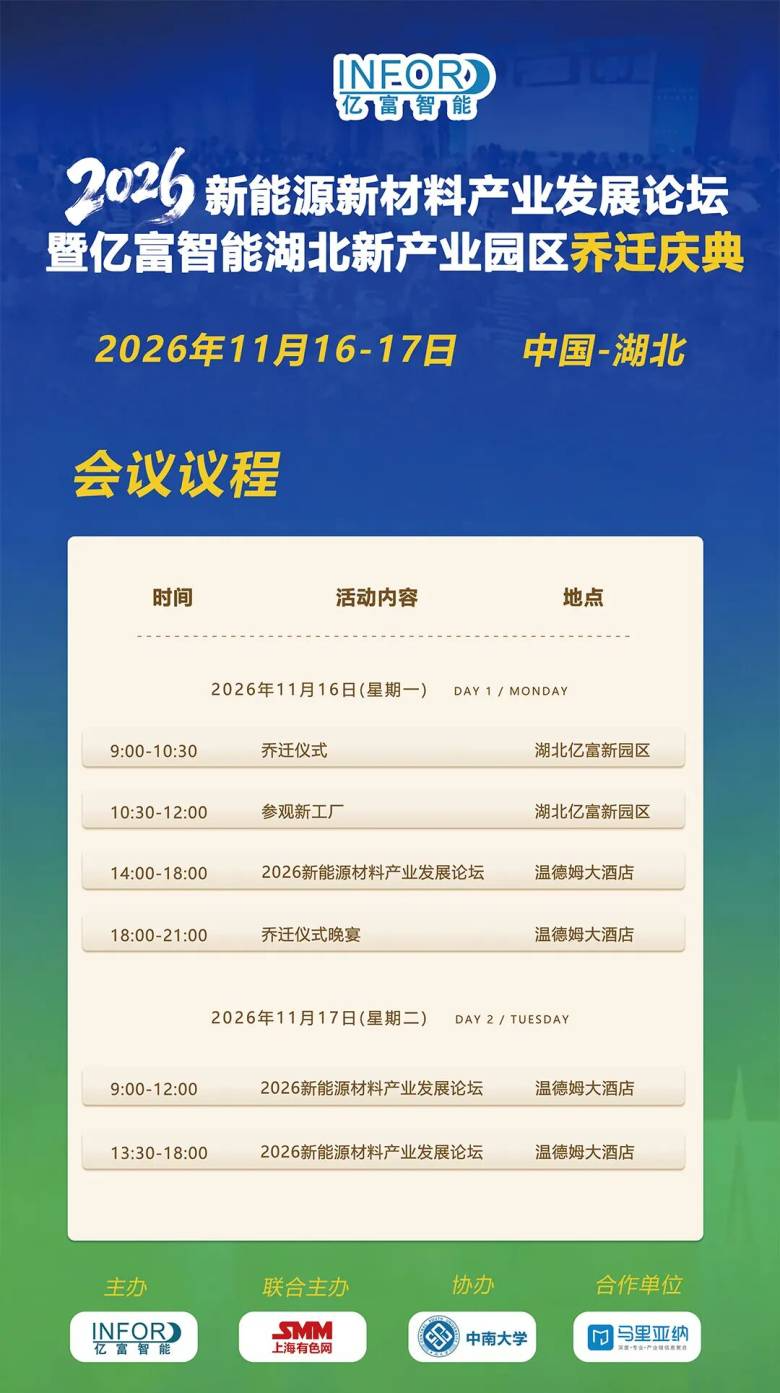
2026 New Energy and New Materials Industry Development Forum and Yifu Intelligent Hubei New Industrial Park Moving Celebration
Time:November 16-17, 2026 | Location: Gucheng, Xiangyang, Hubei, China
Speaker:Liu Taotao (Volkswagen Group (China) battery and module quality control process expert)
Speech Topic:"Observing the Development Trend of Materials and Equipment from OEMs and Consumer Terminals"
Sponsor:Yifu Intelligent
Co-organizer:Shanghai Nonferrous Network
Co-organizer:Central South University
Support:Gucheng County People's Government
 English
 亿富机械
 +86-0769-85626082
 541476175@qq.com
 东莞市大岭山镇颜屋村莲颜路88号
