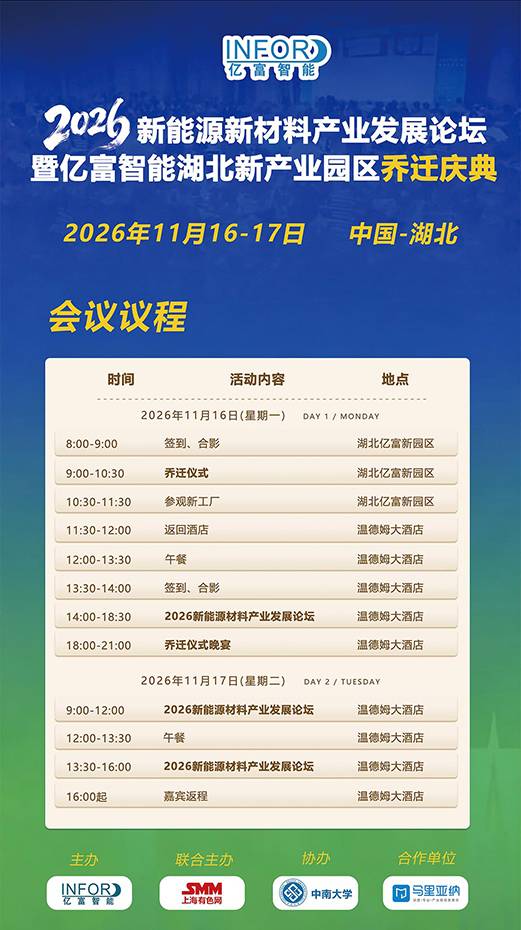
November 16-17, 2026, Gucheng, Xiangyang, Hubei.
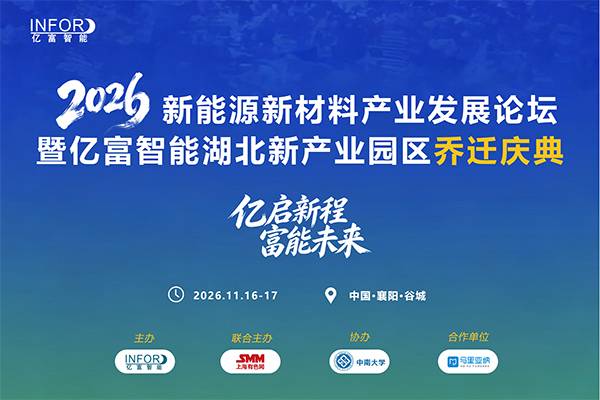
Xinyuan rolled out its production line in Jingchu, and the topic of solid state came to the main table. When Yifu Intelligent Hubei New Industrial Park officially launched the manufacturing capacity of "high-end grinding + dispersion and homogenization" in Gucheng, the discussion of new energy materials has also moved a step forward from "how fine the powder should be" - how can the solid electrolyte take into account both ion conduction and interface stability, so that battery cell factories will be truly willing to put it into quasi-solid-state batteries.
This time, we have invited a scholar who has put polymer electrolytes, inorganic ceramic fillers and battery engineering on the same experimental bench for more than 20 years - Professor Liu Xingquan of the University of Electronic Science and Technology of China. He has officially confirmed to attend the 2026 New Energy and New Materials Industry Development Forum and the Yifu Intelligent Hubei New Industrial Park Housewarming Ceremony, and will bring a keynote report "Research on PEO-based Inorganic Oxide Ceramic Solid State Electrolytes and Their Solid State Batteries".
From PEO chain segments to ceramic interfaces: a veteran who "made it through" solid electrolytes
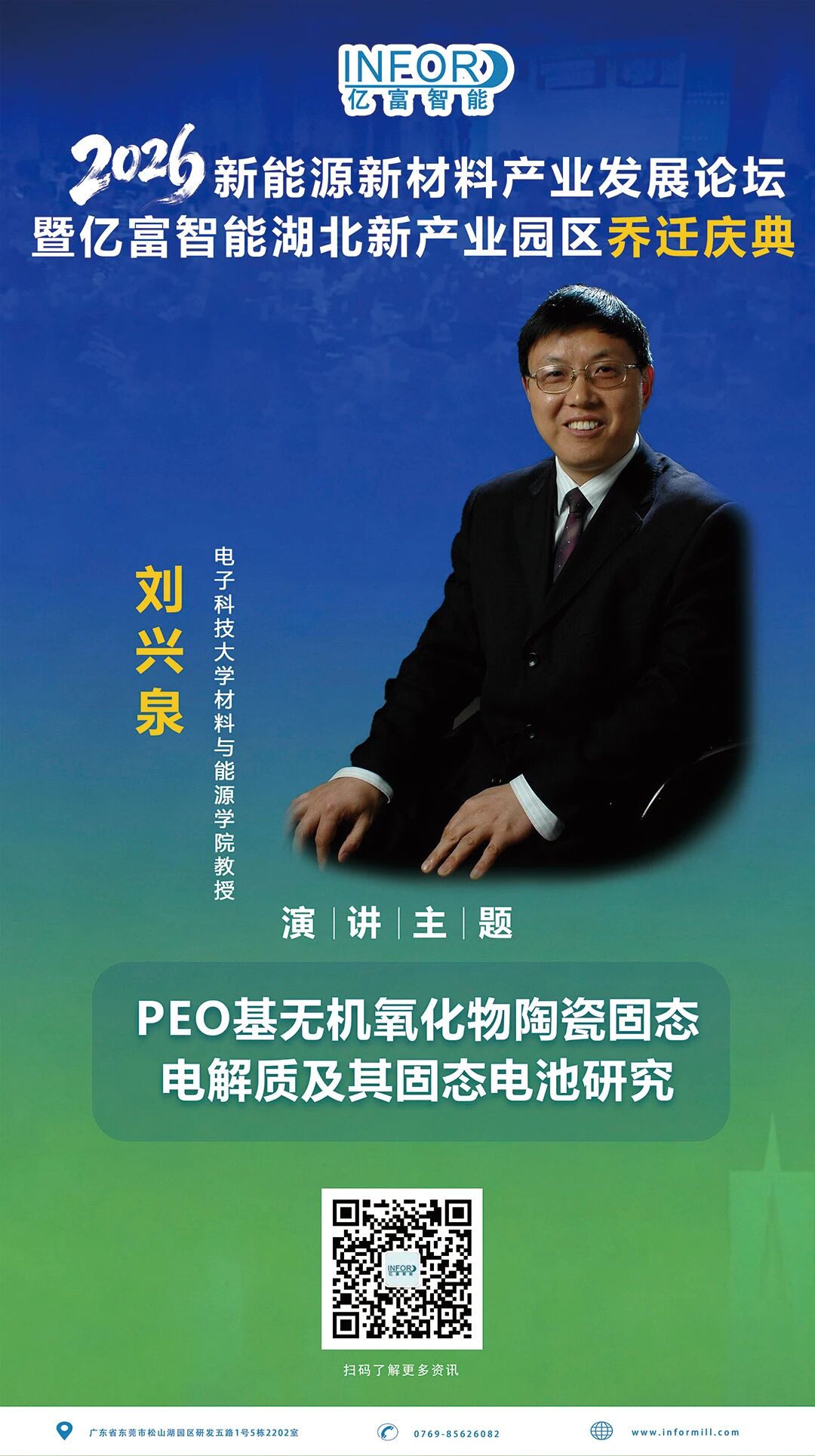
Liu Xingquan—Second-level professor and doctoral supervisor at the School of Materials and Energy, University of Electronic Science and Technology of China, "Light of the West" talent of the Chinese Academy of Sciences, academic and technological leader of Sichuan Province, director of the China Energy Society, standing member of the National Energy Materials and Devices Expert Committee, and innovative figure in high-quality development of the 2021 Chinese Scientists Forum "14th Five-Year Plan".
He has long focused on the four major directions of all-solid-state lithium/sodium battery solid electrolyte, high energy density electrode materials, and lithium-sulfur and sodium-ion battery industrialization. His research style can be summarized in one sentence: from molecular modification to cell verification, and then back to modify the process card.
• PEO-based composite solid electrolyte: Focusing on the composite system of polyethylene oxide (PEO) and garnet-type inorganic ceramics (such as LLZTO), it solves the three old problems of PEO's low room temperature ionic conductivity, Li₂CO₃ passivation layer on the ceramic surface blocking mass transfer, and poor polymer-ceramic interface compatibility;
• Interface ion gate control: We propose a weak solvating molecular ion gate (WSMI) strategy, which chemically anchors the ceramic surface with modified molecules containing carboxyl/trifluoromethyl groups, eats the insulating passivation layer in situ, establishes a local weak solvation environment, and allows Li⁺ to jump in multiple paths between PEO chain segments, ceramic fillers and interface sites;
• Solid-state battery engineering: Make the composite electrolyte achieve a stable cycle of Li||Li symmetrical battery for more than 2000 h, maintain a capacity of 87.8% for 1100 cycles of LiFePO₄ full battery, and simultaneously verify its dendrite suppression ability on the lithium metal anode side;
• Materials-Equipment Collaboration: Hosted the 863 Program of the Ministry of Science and Technology, the National Natural Science Foundation of China and a number of corporate industrialization projects. It was the first in the world to realize pilot testing and industrialization of nickel series, nickel-cobalt-manganese multi-component and lithium iron phosphate cathode materials, and a total of 13 invention patents have been put into production.
Peers commented on his work: "It is not about pouring ceramic powder into PEO and stirring it, but making each ceramic filler grow an ion corridor that can open the door by itself."
In-depth echo with the theme of the forum "New Energy and New Materials"
The "Research on PEO-based Inorganic Oxide Ceramic Solid-State Electrolytes and Their Solid-State Batteries" brought by Professor Liu Xingquan this time happens to be stuck on the hottest solid-state main line of this forum.
The report will start from the movement of PEO matrix chain segments, the intrinsic ion conduction mechanism of inorganic ceramic fillers, the elimination of surface passivation layers and the construction of weak solvation interfaces, all the way to the dendrite suppression on the lithium metal anode side and the full battery cycle performance. It will spread out the entire chain of "material molecular design - powder dispersion process - electrolyte film formation - cell packaging". This means a rare cross-scale alignment for material factories, cell companies and equipment suppliers that are laying out high-security solid-state routes: how the upstream ceramic powder is ground, dispersed, and prevented from agglomeration directly determines the interface defect density of the composite electrolyte; and once the interface defects are amplified to the cell layer, they will become the source of dendrites and thermal runaway.
Yifu's new Hubei campus will put "powder consistency - slurry stability - pole piece yield" on the same site for verification - allowing those who make materials to understand the tolerances of the equipment, and those who make the equipment to understand the impedance of the interface.
The new park opens with an on-site class on "Polymer + Ceramics"
Professor Liu Xingquan will condense the PEO-based composite electrolyte research results accumulated by the team for more than ten years into a hard-core sharing for production line engineers.
Different from purely academic reports, he is better at talking about materials in "process language" - from how to treat hydroxyl groups on the surface of fillers, how to build ion channels in composite membranes, to how to set the slurry viscosity window during roll-to-roll coating, each technical node directly corresponds to the process parameters on the equipment side.
For battery cell companies that are laying out quasi-solid-state production lines, the value of this report is: a materials scientist who has personally set up a pilot line and run a full battery cycle will tell you which "optimal solutions" in the papers are not easy to overturn when amplified, and which overlooked powder details are the watershed for the quality and production of solid-state electrolytes.
 English
 亿富机械
 +86-0769-85626082
 541476175@qq.com
 东莞市大岭山镇颜屋村莲颜路88号