As a key inner component of lithium-ion batteries, separators have a decisive impact on battery safety and electrochemical performance. In the wet coating separator manufacturing process, the dispersion quality of the slurry directly determines the uniformity of the coating and the separator performance. As the core equipment for nano-dispersion of slurry, the sand mill solves the problem of ultra-fine dispersion of ceramic particles, high molecular polymers and special powders through physical grinding force, and has become a key technical support for improving the performance of diaphragms.
1. The core requirement for fine grinding of separator coating slurry
Lithium battery separator ceramic coating slurry is mainly composed of four major components: ceramic particles (such as alumina, boehmite), binders (such as PVDF, PVA), solvents (water-based or oil-based) and functional additives. The particle size distribution and dispersion of ceramic particles play a decisive role in coating performance:
Coarse particles (>1μm) will cause the coating surface to be rough and have uneven porosity, reducing the puncture resistance of the separator
Nanoparticles (<100nm) are prone to agglomeration due to their high specific surface area, forming local accumulation defects
Power batteries have higher requirements for separator performance: high heat resistance (>130°C thermal shrinkage ≤3%), ultra-thin (coating ≤1.5μm) and high ion conductivity. Although nanomaterials such as γ crystalline alumina (dv50=5-100nm) can form dense thin coatings, they are extremely difficult to disperse in deionized water. Van der Waals forces between particles lead to strong agglomeration, making it difficult to deagglomerate using traditional stirring processes. At this time, the high-intensity shear grinding of the sand mill has become the key technical path to break through the dispersion bottleneck.
2. Sand mill technical principles and equipment innovation
The sand mill generates a multi-dimensional collision and shear force field through the grinding media (usually 0.3-2mm zirconia beads) driven by the high-speed rotating rotor to achieve the crushing and dispersion of particles. In diaphragm slurry processing, its technological evolution focuses on three major directions:
1. Improvement of nanoscale dispersion ability
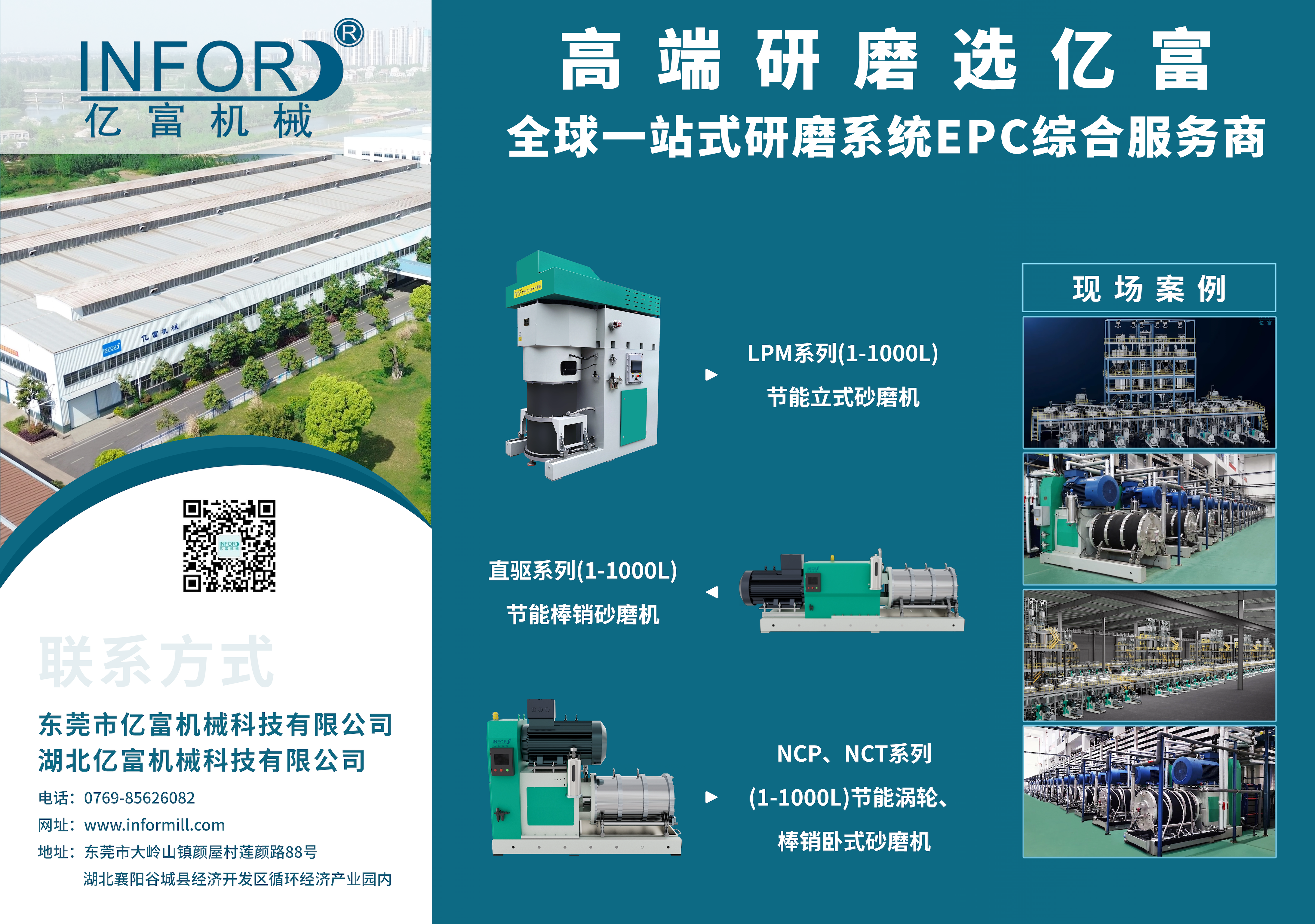
- Yifu rod pin/turbine sand mill adopts a flexible grinding strategy and is equipped with 0.1-2mm zirconium beads
- It can refine ceramic particles to the range of 200nm-2μm
- The axial separator and ceramic sheet separation system avoid slurry degeneration caused by grinding temperature rise
- Yifu series nano sand mill optimizes energy conversion efficiency
- Achieve centralized particle size distribution of materials and reduce the tailing phenomenon of coarse particles
- Significant adaptability to medium and low viscosity slurries
2. Intelligent and modular design
- PLC control system realizes one-click closed-loop operation
- Dynamically adjust speed (800-1, 400rpm), flow rate (0.5-5m³/h) and other parameters
- Significantly reduces manual intervention errors
- The grinding chamber material can be selected from a full ceramic structure or a PU-coated rotor as needed.
- Avoid metal pollution and meet battery material purity requirements (such as Fe content <1ppm)
3. Efficient grinding
- Yifu sand mill dynamic + static discharging technology
- Can be combined with high-speed disperser and transfer tank to form a fully automatic production line
- Achieve zero batch differences in the production of boehmite, alumina and other inorganic slurries
- Large single processing volume and large production capacity
The sand mill has developed from a simple crushing equipment to a "molecular-level designer" of diaphragm performance. With the breakthroughs of domestic equipment in fields such as nano-sand mills, China's lithium battery materials industry is gradually getting rid of its dependence on imports. Leading companies such as Enjie and Putilai have promoted the global market share of domestic separators from less than 30% to more than 65% through vertical integration of equipment-materials-processes (base film-coating-sanding synergy). In the future, sand grinding technology will continue to play a supporting role in new battlefields such as solid electrolyte slurries and nanocomposite coatings, injecting subtle yet powerful Chinese "grinding" power into the trillion-dollar lithium battery industry.

 English
 亿富机械
 +86-0769-85626082
 541476175@qq.com
 东莞市大岭山镇颜屋村莲颜路88号