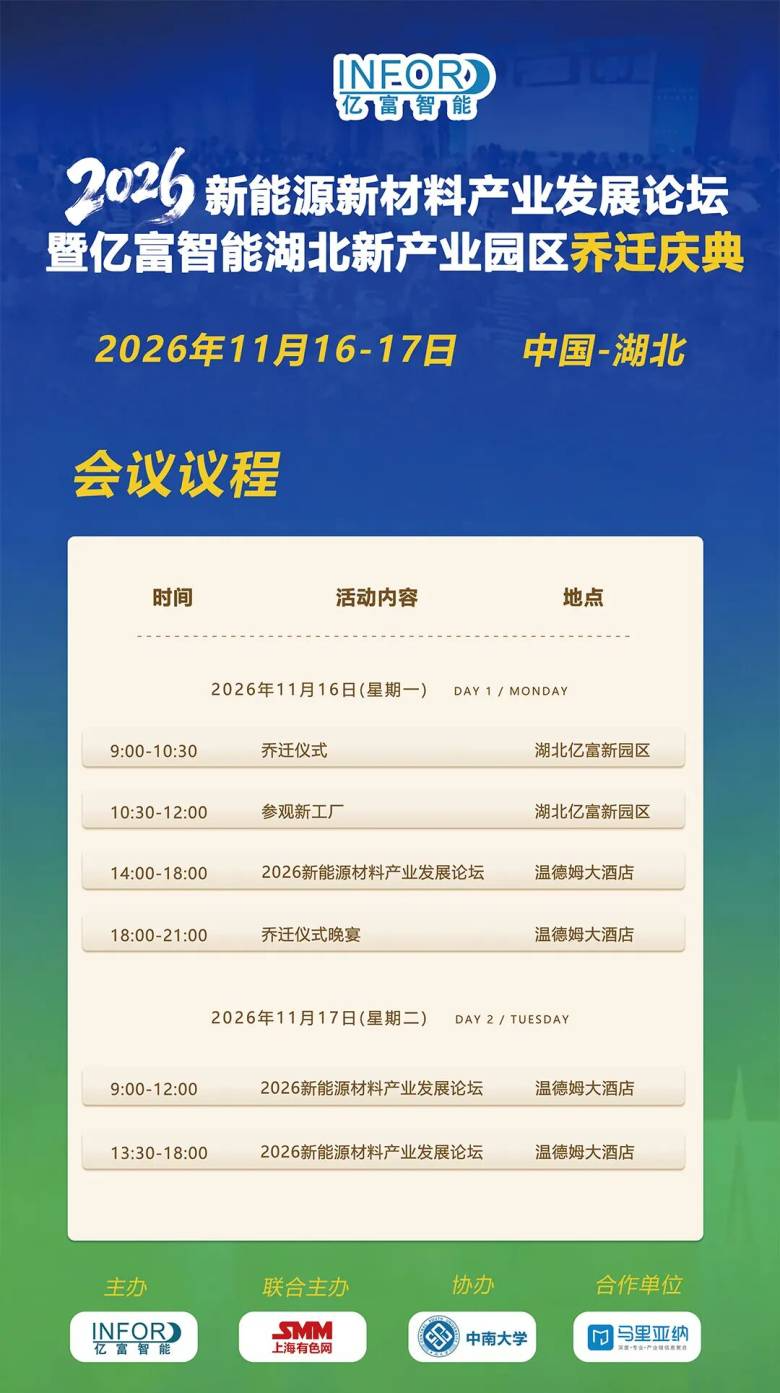
November 16-17, 2026, Gucheng, Xiangyang, Hubei.
Yifu Intelligent Hubei's new industrial park is about to open, and the forum's focus has shifted from "how to grind powder" to "whether the material itself is considered a carbon asset." When the European Union's CBAM enters the payment period and the battery law writes the carbon footprint into the factory certificate, the competition for new energy materials is no longer just about energy density and cost per ton, but also about "how many tons of CO₂ per GWh battery cell carries." Green electricity is one of the solutions, but it is not the only solution.
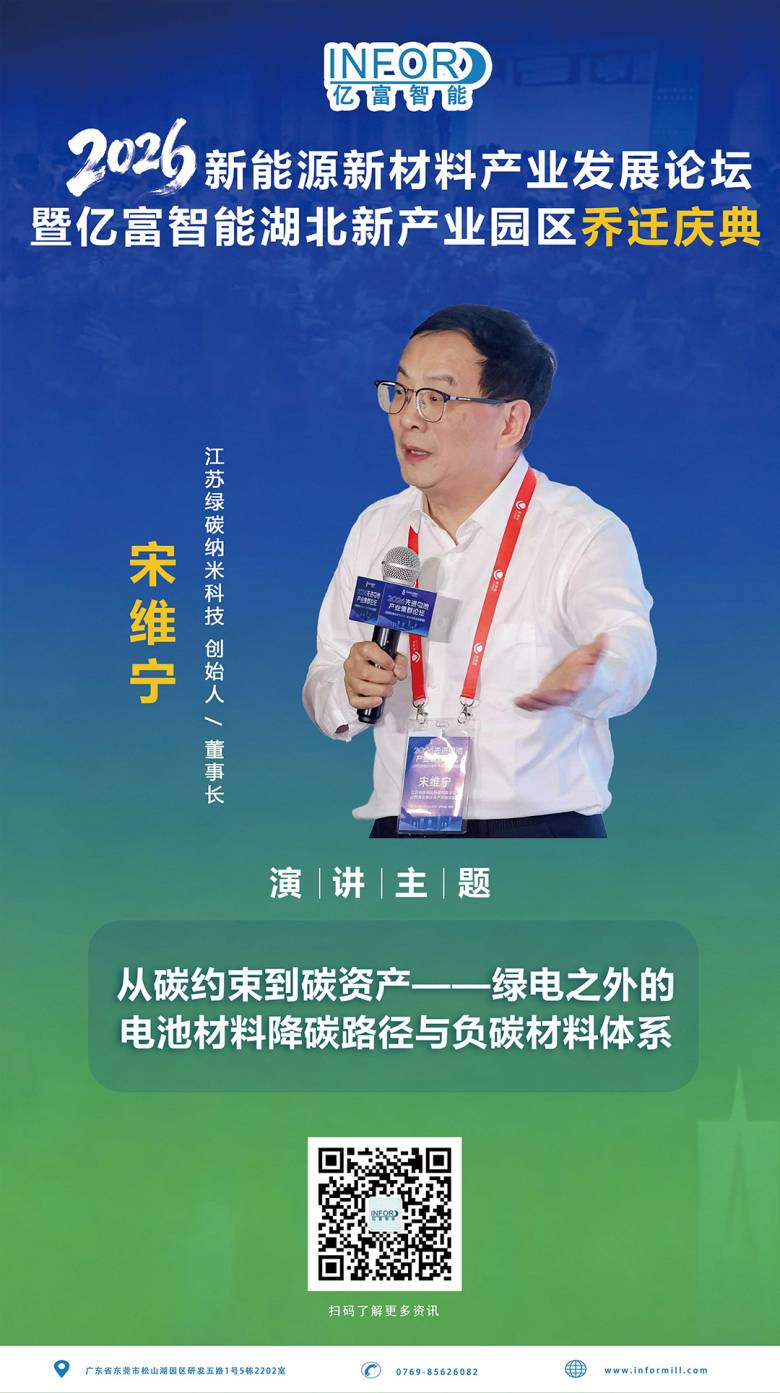
In this round of transition of "from carbon constraints to carbon assets", we invite a game-breaker who directly turns carbon dioxide into battery materials - Song Weining, founder and chairman of Jiangsu Green Carbon Nanotechnology Co., Ltd. Bachelor’s degree from Peking University and PhD from McMaster University in Canada. He founded Green Carbon Nano in 2017. In 2018, he was awarded the title of “Global Climate Trailblazer” by the United Nations Global Climate Action Summit. In 2025, Green Carbon was integrated into the GCL system and became the carbon-based fulcrum of its three-based “silicon-lithium-carbon” industry. He is officially confirmed to attend this forum and the relocation celebration of Yifu Intelligent Hubei New Industrial Park, and will bring a keynote report."From Carbon Constraints to Carbon Assets - Carbon Reduction Pathways and Carbon Negative Material Systems for Battery Materials Beyond Green Electricity". From power plant flue gas to CNT conductive agent, he will transform "negative carbon" from a PPT term into a measurable asset.
The carbon-negative doer who turned "CO₂ electrolysis into carbon nanotubes" into an industrial system
Dr. Song Weining is not a materials dealer in the traditional sense, nor is he a pure environmental protection technician. He spanned multi-disciplinary academic training in mechanics, chemical engineering, materials, and machinery, and brought wood-plastic composite materials from North America to China for industrialization in his early years; In 2015, he formed a team to represent China in the Carbon
He led the team to build the world's first CNT demonstration line for carbon capture from coal-fired flue gas in Datong, Shanxi. Each ton of carbon nanotubes produced consumes approximately 3.5 tons of CO₂; Guangzhou has put into use a fully automatic 4,000-ton CNT lithium battery conductor. The internal resistance of the plasma system is about 60% lower than that of imported carbon black; the first direct air capture (DAC) device in urban buildings in China was launched in Nanjing. The energy consumption per ton of CO₂ is only about 780 kilowatt hours, which is more than 90% lower than the international mainstream. He proposed that "carbon neutrality must not lose money" - use material premiums to cover the cost of carbon reduction, and let conductive agents, conductive plastics, and CNT-copper composite fibers pass through the commercial closed loop first. This perspective of "negative carbon economics" makes him one of the few people in the battery material circle who can connect carbon capture equipment and battery cell BOM tables to calculate accounts.
In-depth echo with the theme of the forum "New Energy and New Materials"
Song Weining's report"From Carbon Constraints to Carbon Assets - Carbon Reduction Pathways and Carbon Negative Material Systems for Battery Materials Beyond Green Electricity" perfectly complements the carbon dimension puzzle of this forum's "New Materials Drive New Batteries":
Path layer - Green electricity solves the problem of "electricity end emissions", but precursor synthesis, high-temperature sintering, and CVD conductive agents still have carbon footprints. Green carbon’s answer is to make CO₂ into CNT: electrolysis replaces CVD, and there are no three wastes in the whole process. Each ton of CNT has a net carbon reduction of several tons in the entire life cycle, and the conductive agent changes from a "high energy-consuming additive" to a "negative carbon carrier."
Material layer - CNT conductive slurry improves the uniformity of the conductive network of the pole piece, reduces internal resistance, and enhances magnification and circulation; the introduction of a negative carbon conductive skeleton into the hard carbon/silicon carbon negative electrode can simultaneously optimize the dispersion stability and carbon bill; in the future, CNT-aluminum and CNT-copper composite materials can also reduce the weight of the entire vehicle.
Asset layer - under the EU battery law, carbon footprint data is the order threshold. Whoever can write "capture volume, conversion ratio, energy consumption, batch LCA" into the material certificate will turn CO₂ from a cost item into a tradable asset.
For the material factory, it answered "how to reduce the carbon account without changing the cathode system"; for the equipment factory, it reminded the sanding and dispersion system to adapt to CNT high aspect ratio slurry, low residue and online carbon data collection; for Yifu, it means that the output of the new park production line is not only the particle size CV value, but also the auditable negative carbon process package. The next step in reducing carbon emissions is not to buy more green certificates, but to allow materials to "eat carbon" on their own.
In the golden autumn of November, Gucheng’s new garden opens
From November 16th to 17th, the new park and forum opened simultaneously in Gucheng, Xiangyang, Hubei. Let’s listen to Song Weining from the front line of the green carbon-GCL industry explain clearly “in addition to green electricity, how battery materials can be redone with a carbon-negative system”; and also see how Yifu’s new production line uses high-precision dispersion to catch the industrialization pace of CNT slurry from the carbon-negative workshop to the battery pole pieces. The relocation is not a ribbon-cutting, but a re-recording of the carbon account of China's battery materials in Gucheng by Yifu and Green Carbon.
Start a new journey with you in Gucheng, see you there!
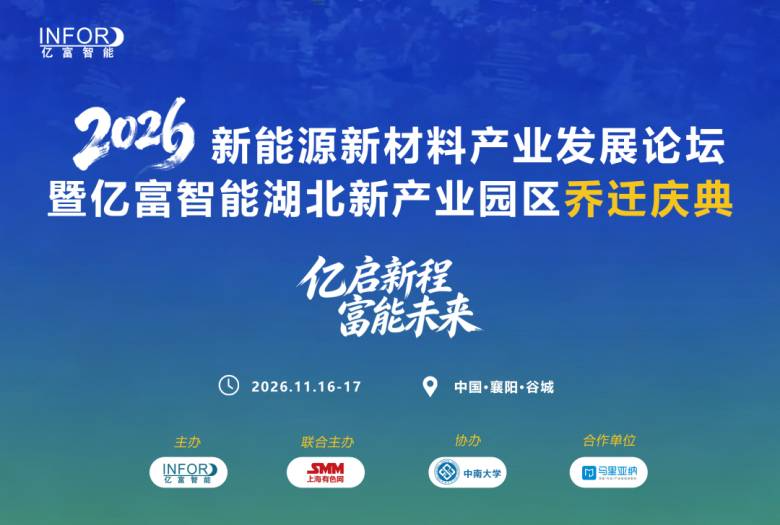
2026 New Energy and New Materials Industry Development Forum and Yifu Intelligent Hubei New Industrial Park Moving Celebration
Time:November 16-17, 2026 | Location: Gucheng, Xiangyang, Hubei, China
Speaker:Song Weining (Founder and Chairman of Jiangsu Green Carbon Nanotechnology)
Speech Topic:"From Carbon Constraints to Carbon Assets - Carbon Reduction Pathways and Carbon Negative Material Systems for Battery Materials Beyond Green Electricity"
Sponsor:Yifu Intelligent
Co-organizer:Shanghai Nonferrous Network
Co-organizer:Central South University
Support:Gucheng County People's Government
 English
 亿富机械
 +86-0769-85626082
 541476175@qq.com
 东莞市大岭山镇颜屋村莲颜路88号